


From Farm Waste to a Sustainable Source of Income
In the fields of Uttarakhand, okra—or bhindi—is a familiar vegetable crop. But once the pods are harvested, the plant stems, which remain in the fields in large quantities, are generally treated as waste. Traditionally, much of this biomass is discarded or used only as fuel, leaving behind a largely untapped resource.
Yet, hidden within these discarded stems is a strong, renewable and biodegradable natural fibre.
Okra is a rich source of natural fibre, containing about 60–70% cellulose. The fibre is bright, shiny and strong, with characteristics comparable to conventional bast fibres such as jute, Bhimal (Grewia optiva), flax and hemp. With appropriate processing, it can be converted into yarn and used for textiles, handicrafts and a range of value-added products.
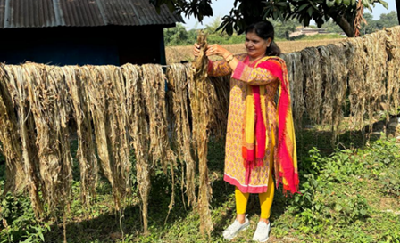
Recognising this potential, Krishi Vigyan Kendra (KVK), Dehradun explored an innovative question: Could the stems left behind after harvesting okra become a source of livelihood for rural women?
The answer was found by bringing together scientific fibre-processing techniques and Uttarakhand’s rich tradition of natural-fibre handicrafts.
Blending Traditional Knowledge with Scientific Innovation
Uttarakhand has a long tradition of working with natural fibres such as sisal, agave, Bhimal, jute, hemp, wool and nettle. Rural artisans have traditionally transformed these fibres into baskets, rugs, shawls and other utility and decorative products.
KVK Dehradun built on this existing knowledge base and introduced okra fibre as a new raw material for handicraft production. The intervention provided rural women artisans with the scientific knowledge required to extract, process and utilise fibre from okra stems, while allowing them to retain the traditional skills they already possessed.
Between 2021 and 2023, seven training programmes were organised in villages including Charba, Bhood, Horawala, Sherpur and Dhalipur. Around 250 rural women artisans, already engaged in traditional fibre crafts, were trained in the new technology.
To deepen their skills, KVK Dehradun also organised a 21-day intensive skill development programme in collaboration with an NGO. The programme focused on fibre extraction, processing, product development and design diversification.
The objective was not simply to teach women how to extract fibre, but to help them transform an agricultural residue into a marketable, value-added product and a potential source of supplementary income.
The Journey from Stem to Fibre
The transformation begins in the field.
Mature okra plants are harvested when their stems contain sufficiently strong fibres. The stems are separated, bundled and prepared for retting. Traditionally, bundles containing around 30–50 stems are immersed in soft water in concrete tanks for approximately 10–14 days.
This process, known as retting, helps break down the materials that bind the fibre bundles to the woody core. The stalks are subsequently tapped gently with a wooden hammer to loosen the softened pulp.
The fibre is then manually separated from the woody core through decortication. It is thoroughly washed to remove residual pectin, dirt and other impurities and subsequently dried in sunlight for about 48 hours.
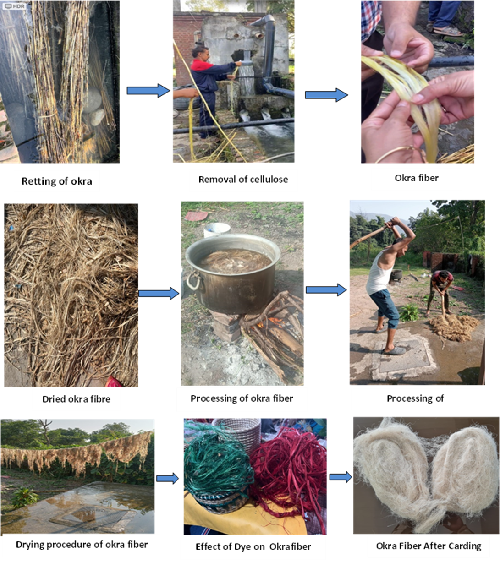
For further refinement, the fibre can undergo chemical treatment to reduce excess lignin using a bath system involving sodium hydroxide (NaOH), sodium carbonate (Na₂CO₃), hydrogen peroxide (H₂O₂), a sequestering agent and a wetting agent.
Once processed and dried, the fibres are carded and spun into yarn, making them suitable for further use in handicrafts and textile applications.
Thus, what was once discarded as agricultural residue is transformed through a sequence of simple but scientific processes into a usable natural fibre.
From Fibre to Finished Products
The real transformation, however, happens when the fibre reaches the hands of trained artisans.
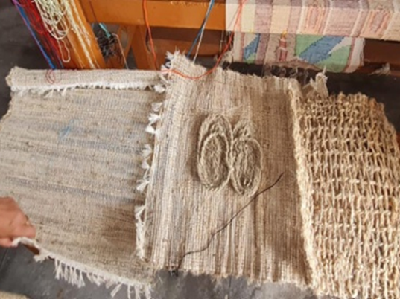
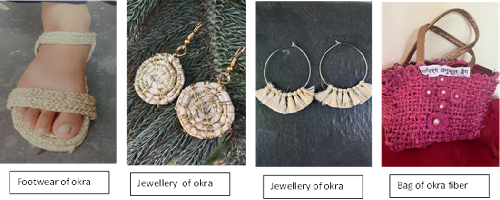
Using their existing craftsmanship, the women began incorporating okra fibre into a variety of products, including baskets, coasters, decorative articles, footwear and household utilities.
The intervention therefore created a bridge between farm-level waste management and rural enterprise development.
Instead of viewing the okra stem as an unwanted residue, it became a raw material with economic value. At the same time, traditional handicraft skills acquired over generations were given a new dimension through the introduction of an unconventional, locally available fibre.
A New Opportunity for Rural Women
The impact of the intervention extended beyond technical skill development.
According to the women involved in producing the handicrafts, income from the sale of okra-fibre products was 20–30% higher than that from other fibre products. The new activity provided an opportunity for rural women to earn additional income while utilising their existing skills and available time more productively.
The training programmes resulted in noticeable improvements in knowledge, skills and adoption. Sixty-six per cent of artisans fully accepted the quality and fineness of okra fibre, while 52% appreciated the improved designs, packaging and presentation practices introduced through the intervention.
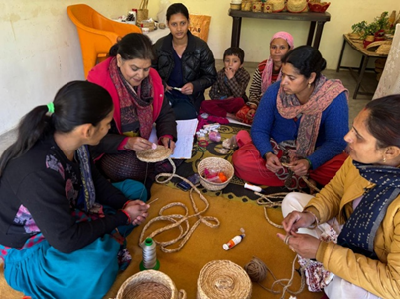
The initiative also encouraged livelihood diversification. A considerable number of women began adopting okra-fibre handicrafts as a supplementary occupation, thereby creating an additional avenue for household income.
For the artisans, the intervention was not merely about learning another craft. It was about discovering economic value in a resource that had previously been overlooked.
Turning Agricultural Waste into Value
The initiative also demonstrates the potential of circular and sustainable approaches to rural development.
Large quantities of okra stems that were earlier left in the fields or used as fuel could now be utilised as a source of biodegradable natural fibre. This improved the utilisation of agricultural biomass while reducing waste and creating an alternative raw material for handicraft production.
In this way, the intervention connected three important objectives:
agricultural waste utilisation, women-led livelihood generation and sustainable handicraft development.
The approach also strengthened collective production and marketing systems and created possibilities for developing organised clusters of rural artisans.
Impact Beyond Income
The success of the initiative can be viewed across multiple dimensions.
Income Generation:
Women artisans gained an additional source of income through the sale of okra-fibre handicrafts, with reported returns 20–30% higher than those from other fibre products.
Women Empowerment:
Training enhanced the skills, confidence, decision-making ability and entrepreneurial orientation of women involved in the activity.
Livelihood Diversification:
Okra-fibre handicrafts emerged as a supplementary occupation, enabling women to utilise their existing skills and available time productively.
Sustainable Resource Utilisation:
Agricultural residue that was previously discarded was converted into biodegradable and marketable products.
Preservation and Modernisation of Traditional Skills:
Existing indigenous fibre-craft practices were strengthened by introducing a new raw material and improved processing and design techniques.
Enterprise and Market Potential:
Improved product design, packaging, branding and exposure to wider markets created opportunities for better price realisation and enterprise development.
The Road Ahead: From Innovation to Enterprise
While the results are encouraging, the intervention also highlighted areas that require further attention.
The artisans identified limited knowledge of modern market trends (88%), low wage realisation (82%) and irregular availability of raw materials (78%) among the key constraints.
Addressing these challenges will be critical to taking the initiative from a successful training intervention to a sustainable rural enterprise model.
Future efforts can focus on strengthening market linkages and branding, improving entrepreneurship and marketing skills, establishing reliable raw-material supply chains and promoting cluster-based production systems. Greater attention to product design, packaging, quality standardisation and access to wider markets can further enhance the commercial potential of okra fibre.
A Model with Potential for Replication
The story of okra fibre in Dehradun demonstrates that innovation does not always require an entirely new resource. Sometimes, the opportunity lies in seeing value where others see waste.
By combining the scientific knowledge of fibre extraction with the traditional craftsmanship of rural women, KVK Dehradun transformed an underutilised agricultural residue into a potential source of income, enterprise and sustainable production.
What was once an abandoned okra stem is now a raw material for handicrafts. What was once agricultural waste has become an opportunity for livelihood diversification.
The experience offers a promising model for other regions where agricultural residues are available in abundance and traditional craft skills continue to thrive. With stronger market systems, organised raw-material supply and continued capacity building, okra fibre has the potential to move beyond an innovative rural craft and emerge as a sustainable livelihood enterprise.
The initiative ultimately reinforces a simple but powerful idea: when science meets traditional knowledge, even agricultural waste can be transformed into an asset—and an asset can become a livelihood.



Like on Facebook
Subscribe on Youtube
Follow on X X
Like on instagram