

For Mr. Swuyievezo Dzudo of Porba village in Phek district, Nagaland, farming is more than a livelihood it is a way of life rooted in his family’s agricultural background. Holding an M.Sc. in Botany, he chose farming as his profession after completing his postgraduate studies and diversified his 10-hectare farm across agricultural, horticultural and medicinal crops, along with livestock. Among these, kiwi has emerged as an important component, with 400 plants cultivated over 0.80 ha with the active support of his family.
Kiwi is particularly significant in Phek district, where the crop has been identified under the One District One Product (ODOP) initiative because of its strong production potential and growing market demand. The district accounts for 113 ha under kiwi cultivation, producing 410 MT, while Nagaland as a whole has 382.04 ha under the crop with a production of 1,638.55 MT, according to the Statistical Handbook of Nagaland, 2025.
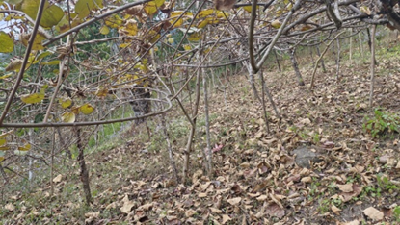
However, despite the promising potential of kiwi cultivation, a critical challenge was limiting productivity. Many orchards in the region lacked proper vine support and systematic training. As a result, vines often grew in a congested and irregular manner, restricting sunlight penetration and air circulation and making routine orchard operations difficult. These constraints ultimately affected flowering, fruit set, fruit quality and productivity. Mr. Dzudo’s orchard faced a similar challenge: although the vines were healthy and land resources were adequate, yields remained moderate.
A Scientific Intervention to Reshape the Orchard
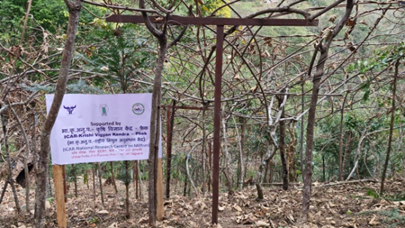
Recognizing the need to improve orchard management, ICAR–Krishi Vigyan Kendra (KVK), Phek began providing Mr. Dzudo with technical guidance and capacity-building support on improved kiwi cultivation, nursery raising and post-harvest management in 2018. To address the specific challenge of vine support and systematic training, ICAR–KVK Phek, in collaboration with ICAR–Vivekanand Parvatiya Krishi Anusandhan Sansthan (VPKAS), Almora, introduced the T-bar trellis system for kiwi growers of Phek district under the NEH Programme in 2024. The technology was subsequently installed in Mr. Dzudo’s kiwi orchard.
The intervention went beyond simply installing the trellis. The farmer was guided in scientific vine training, canopy management, balanced pruning and maintaining a uniform spread of vines across the trellis. This transformed the orchard from a congested arrangement of vines into a more organized and productive canopy structure.
Better Canopy, Better Crop Performance
The impact of the intervention became visible in the overall structure and management of the orchard. With the T-bar trellis system, the vines were trained horizontally and distributed more uniformly, replacing the earlier congested growth pattern. The canopy became more open and well distributed, allowing better and more uniform sunlight interception and improved air circulation.
The improved architecture also made pruning and harvesting more systematic and less labour-intensive. Flowering and fruit set improved, while the fruits became more uniform in size and quality, enhancing their market appeal.
Most importantly, these improvements translated into higher productivity without increasing either the cultivated area or the number of plants. Earlier, the 0.80-ha orchard with 400 plants produced around 800–900 kg of kiwi. Following the introduction of the T-bar trellis system and scientific vine training, production increased to approximately 960–1,170 kg, representing an improvement of about 20–30 per cent.
Productivity Gains with Multiple Benefits
The benefits extended beyond increased yield. Improved sunlight penetration and air circulation, reduced vine congestion, enhanced flowering and fruit set, better fruit size and quality, and easier intercultural, plant protection and harvesting operations collectively improved the efficiency of orchard management. The improved canopy environment also helped minimize disease incidence, while reduced labour requirements for pruning and harvesting added to the practical benefits for the farmer.
For Mr. Dzudo, the experience has been encouraging. Expressing satisfaction with the T-bar trellis system, he acknowledged that scientific vine training significantly improved both orchard management and productivity. His experience has also encouraged him to share the benefits of the technology with neighbouring farmers, motivating them to consider similar systems in their kiwi orchards.
A Simple Change with a Significant Impact
The experience of Mr. Dzudo demonstrates that improving farm productivity does not always require expanding the cultivated area or increasing the number of plants. In this case, the key was to make better use of the resources already available. Scientific vine training and canopy management enabled more efficient utilization of sunlight, air and nutrients, creating conditions conducive to improved flowering, fruit set and fruit development.
The success of the intervention highlights the potential of the T-bar trellis system, combined with scientific canopy and vine management, as a practical and sustainable approach for enhancing kiwi productivity under normal field conditions. With improved yields, better fruit quality, easier orchard operations and reduced labour requirements, the technology offers a promising pathway for kiwi growers in Nagaland and has potential for wider replication across Phek district, contributing to improved farm incomes and livelihood outcomes.
(Source: ICAR–Krishi Vigyan Kendra, Phek, Nagaland)



फेसबुक पर लाइक करें
यूट्यूब पर सदस्यता लें
X पर फॉलो करना X
इंस्टाग्राम पर लाइक करें