


12 October 2026, New Delhi
The Indian Council of Agricultural Research (ICAR) and the Agriculture and Rural Development Wing (ARDW) of the Rajyoga Education and Research Foundation of Prajapita Brahma Kumaris Ishwariya Vishwa Vidyalaya have signed a Memorandum of Understanding (MoU) for cooperation in agricultural research, education and extension in order to promote sustainable, climate-resilient and holistic agricultural systems by combining scientifically validated crop-production technologies with the principles of Shashwat Yogic Kheti.
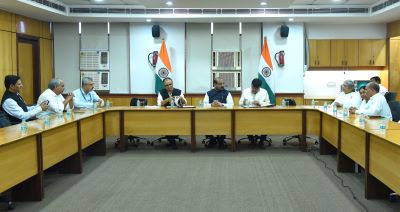
The MoU was signed today, at NASC, PUSA, New Delhi, by Dr Rajbir Singh, Deputy Director General (Agricultural Extension), ICAR and Ms. B.K. Asha, Member, Management Committee, BK, Karol Bagh, New Delhi on behalf of Indian Council of Agricultural Research and Agriculture and Rural Development Wing (ARDW), The Brahma Kumaris, respectively, in the august presence of Dr M. L. Jat, Secretary, DARE & Director General, ICAR, Dr Rajarshi Roy Burman, Assistant Director General (Agril. Ext.), Dr Ranjay K. Singh, ADG (Agril. Ext.), Principal Scientists of Division of Agricultural Extension, ICAR as well as other representatives of Agriculture and Rural Development Wing (ARDW), The Brahma Kumaris.
The MoU outlines cooperation to improve soil health, environmental sustainability, farmers’ livelihoods and well-being. Shashwat Yogic Kheti, as described in the MoU, emphasises environmentally responsible and residue-conscious farming, water conservation, natural-resource management and the integration of Rajyoga meditation and positive awareness into farming activities.
A key proposal under the MoU is the establishment of a Centre of Excellence on Shashwat Yogic Kheti. The proposed Centre would support collaborative research, technology validation, farmer training and demonstration programmes, subject to mutually agreed programmes and the availability of financial resources under applicable government schemes.
The two organisations also envisage jointly developing, validating and disseminating Good Agricultural Practices (GAP), Standard Operating Procedures (SOPs) and farmer-friendly technologies. The collaboration may facilitate the exchange of scientists, technical experts, resource persons and training materials, alongside national and international conferences, workshops, capacity-building initiatives, exposure visits and farmer–scientist interactions.
For wider outreach, the MoU provides an umbrella framework through which mutually agreed activities may be undertaken by ICAR institutes, Agricultural Technology Application Research Institutes, Krishi Vigyan Kendras (KVKs), State Agricultural Universities (SAUs) and Brahma Kumaris centres across the country, subject to approval of the respective competent authorities and applicable rules. The aim is to strengthen the dissemination and adoption of appropriate agricultural technologies among farmers.
Implementation is envisaged through jointly developed biennial work plans. The MoU also provides for a Joint Working Group, with representatives of both parties, to review implementation and suggest measures for further development. Each party would ordinarily bear its own costs unless otherwise agreed in writing, and activities would be undertaken in accordance with applicable rules and mutually agreed arrangements.
The MoU reflects an effort to bring together ICAR’s agricultural research and extension expertise and ARDW’s value-based approach to sustainable farming, with a focus on farmer capacity-building, responsible management of natural resources and sustainable rural development.
(Source: Agricultural Extension Division, ICAR)



Like on Facebook
Subscribe on Youtube
Follow on X X
Like on instagram