


9–10 September 2026, Ri-Bhoi, Meghalaya
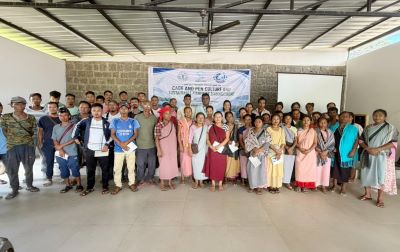
In a significant initiative to strengthen tribal livelihoods, women-led fisheries enterprises and sustainable inland fisheries development in Northeast India, the Department of Fisheries, Government of Meghalaya, in collaboration with ICAR–Central Inland Fisheries Research Institute, Regional Centre, Guwahati, organized a two-day training programme on “Cage & Pen Culture and Sustainable Reservoir Fisheries Management” on 9–10 September 2026 at Ri-Bhoi, Meghalaya.
Sponsored under the Pradhan Mantri Matsya Sampada Yojana (PMMSY), the programme brought together around 150 participants, including tribal fishers, members of Women Self-Help Groups (SHGs) and community leaders. The training aimed to equip local communities with scientific knowledge, practical skills and improved technologies for cage and pen culture, sustainable reservoir fisheries management and productive utilization of inland water resources.
During the inaugural session, Shri Jonathan Suchiang, Joint Director of Fisheries, Government of Meghalaya, highlighted the strategic importance of reservoir fisheries in enhancing fish production, employment and livelihood opportunities for local communities.
She highlighted that the successful implementation of the ICAR-CIFRI project in Umiam Reservoir, including field-level interventions in cage culture, has demonstrated the potential of scientific fisheries technologies in the state. The experience has further encouraged the Department of Fisheries, Government of Meghalaya, to initiate an Integrated Reservoir Development Project under PMMSY.
The programme placed strong emphasis on hands-on learning and field-oriented technology transfer. Scientists from ICAR-CIFRI provided practical guidance to fishers and women beneficiaries on improved cage culture practices, stocking, management and production enhancement.
The technical sessions focused on scientific cage culture and sustainable management of reservoir fisheries. The session on cage culture highlighted the scientific refinement of cage culture protocols suited to the mid-altitude reservoirs of Meghalaya, along with improved production practices for enhancing fish growth, survival and overall productivity.
The session on sustainable reservoir fisheries management emphasized the need to balance enhanced fish production with ecological sustainability, resource conservation and long-term productivity of reservoir ecosystems.
A practical case-study demonstration of cage and pen culture technologies adopted in Meghalaya and other parts of the country enabled participants to understand the application of these technologies under reservoir conditions. Interactive discussions involving fishers, women’s groups, community representatives, scientists and fisheries officials provided a platform to identify field-level challenges and explore locally suitable solutions.
A key highlight of the programme was its focus on women’s participation and entrepreneurship in fisheries.
Reflecting on the initiative, Dr Pradip Dey, Director, ICAR-CIFRI, emphasized that reservoirs should be developed as living economic assets for sustainable livelihoods, entrepreneurship and inclusive rural prosperity, rather than merely as sources of fish production.
Dr Dey stressed that “technology becomes truly meaningful when it reaches the hands of communities and changes lives,” with science, indigenous knowledge and innovation working together to create resilient livelihood models. He reaffirmed ICAR-CIFRI’s commitment to building a gender-responsive, technology-driven and community-owned fisheries ecosystem across Northeast India, contributing to Blue Revolution 2.0 and India’s sustainable blue economy.
The initiative represents ICAR-CIFRI’s continued efforts to develop, demonstrate and refine scientifically validated fisheries technologies suited to the ecological conditions of mid-altitude reservoirs of Northeast India.
Reservoir fisheries have considerable potential to become a sustainable engine of employment, entrepreneurship and rural economic development, particularly for tribal and women fishing communities. The initiative reinforces the shared commitment of ICAR-CIFRI and the Department of Fisheries, Government of Meghalaya, to take “science from the laboratory to the community” and enable tribal fishers and women to become active drivers of sustainable fisheries development in Northeast India.
(Source: ICAR-Central Inland Fisheries Research Institute, Barrackpore)



Like on Facebook
Subscribe on Youtube
Follow on X X
Like on instagram