


3 November 2026, Gangasagar
As a major initiative to strengthen climate-resilient livelihoods and enhance inland fish production in the vulnerable Sundarbans region, ICAR-Central Inland Fisheries Research Institute, Barrackpore, in collaboration with Ramakrishna Ashram KrishiVigyan Kendra (KVK), Nimpith, provided scientific and input support to 206 fish farmers belonging to Scheduled Caste communities across three Gram Panchayats of Gangasagar, West Bengal. The initiative was implemented under the Scheduled Caste Sub-Plan (SCSP) and KhetBachaoAbhiyan, with a focus on promoting sustainable fisheries-based livelihoods, increasing inland fish production, strengthening climate resilience and improving the income security of vulnerable farming communities.
Located in the cyclone- and flood-prone coastal ecosystem of the Sundarbans, Gangasagar faces recurring challenges from extreme weather events, coastal inundation and associated disruptions to agriculture and fisheries-based livelihoods. Recognising the need for location-specific interventions, ICAR-CIFRI and KVK Nimpith joined hands to promote scientific pond-based aquaculture as a viable pathway towards livelihood security, income enhancement and climate resilience.
Under the initiative, each of the 206 beneficiary farmers received a comprehensive aquaculture input kit comprising 70 kg of supplementary fish feed, 6 kg of Indian Major Carp (IMC) fish seed and 10 kg of agricultural lime. The support is designed to improve pond productivity, facilitate better fish growth and strengthen household-level fish production through scientific utilisation of available water resources.
Beyond input distribution, the programme placed strong emphasis on technology transfer and capacity building. Scientists from ICAR-CIFRI, interacted directly with the farmers and provided practical guidance on scientific pond preparation, water quality management, balanced feeding, fish seed management and improved aquaculture practices. The interaction equipped farmers with essential knowledge to adopt productive and sustainable fish farming practices under local agro-climatic conditions.
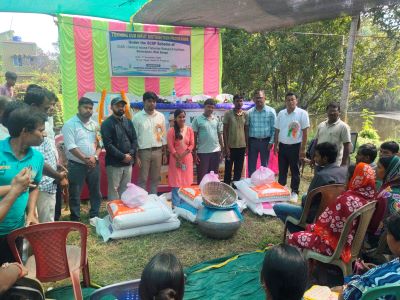
Reflecting on the occasion, Dr Pradip Dey, Director, ICAR-CIFRI, highlighted the strategic role of fisheries in building climate-resilient and sustainable livelihoods in vulnerable coastal and island ecosystems. He emphasised that the geographical and climatic challenges of Gangasagar necessitate location-specific, science-led and community-oriented interventions. Referring to the objectives of the Khet Bachao Abhiyan, he underscored the importance of bridging the gap between fisheries research and field-level application through technology dissemination, capacity building and critical input support, particularly for Scheduled Caste fish farmers. He further highlighted the potential of inland fisheries to diversify livelihoods, enhance household income and nutritional security, generate rural employment and strengthen the socioeconomic resilience of vulnerable island communities.
The programme also provided an important platform for advancing the objectives of Khet Bachao Abhiyan, with experts highlighting the need for integrated and resource-efficient farming systems. Key messages included soil-test-based nutrient management, judicious use of agrochemicals, scientific pond management, recycling of farm resources and adoption of climate-resilient agricultural practices. The emphasis was on creating synergies between agriculture and fisheries to improve overall farm productivity while conserving the ecological resources on which rural livelihoods depend.
The initiative represents a significant step towards taking science from laboratories to farmers' ponds, demonstrating the value of institutional convergence between ICAR-CIFRI and KVK Nimpith in addressing the livelihood challenges of climate-vulnerable communities. By combining quality inputs, scientific knowledge and direct technical guidance, the programme seeks to transform pond-based aquaculture into a more productive, sustainable and climate-resilient livelihood option for the farming households of Gangasagar.
Through such farmer-centric interventions, ICAR-CIFRI reaffirms its commitment to inclusive fisheries development, sustainable utilisation of inland water resources and building climate-resilient rural livelihoods in the Sundarbans.
(Source: ICAR-Central Inland Fisheries Research Institute, Barrackpore)



Like on Facebook
Subscribe on Youtube
Follow on X X
Like on instagram