


In a landmark development for pig genomics and indigenous pig conservation, scientists at the ICAR-National Research Centre on Pig in Guwahati, Assam, have generated the first de novo chromosome-scale whole-genome sequence and functional annotation of an indigenous Indian pig breed, the Doom pig. Prevalent to the Brahmaputra Valley, the Doom pig has long been reared under low-input, semi-scavenging systems and is recognized by local communities for its exceptional environmental hardiness and notable tolerance to devastating viral infections particularly African swine fever. Until now pig genetics and immunogenomic studies across South Asia were constrained by reliance on Western commercial genomes or the single Sus scrofa telomere-to-telomere reference which fail to capture native structural variations, unique copy-number variants and distinct regulatory regions.
To overcome these limitations the research team isolated high-molecular-weight genomic DNA from a purebred male Doom pig and performed third-generation sequencing. Utilizing high-accuracy basecalling generated 15.74 million quality-filtered long reads totalling 129.9 Gb which equates to approximately 48X coverage of the estimated 2.7 Gb genome with an average read length of 11,075bp. Repeat-graph assembly generated a completely gap-free primary contig assembly of 2.524 Gb across 3,719 contigs with an impressive contig of 12.0 Mb and zero unresolved bases. Benchmark Universal Single-Copy Orthologs evaluation against the artiodactyla_odb12 database has confirmed high biological completeness at 99.0%.
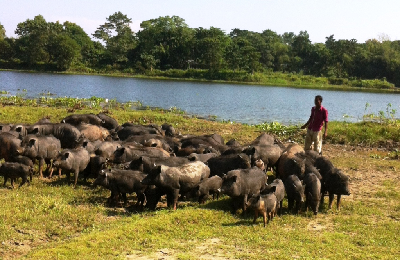
Highlighting its biological importance, Principal Scientist stated, "Standard international assemblies miss key regional variants, but this gap-free long-read assembly successfully untangles complex repetitive regions and immune loci, providing the molecular baseline to understand why Doom pigs naturally withstand harsh climates and severe viral threats like ASF."
Structural annotation predicted 30,299 protein-coding genes, with functional annotation mapping 18,667 genes and assigning 497,810 Gene Ontology terms dominated by biological processes linked to cell surface signaling, inflammatory modulation, and innate antiviral defense cascades that including macrophage-specific receptors like CD163 and SIGLEC1 alongside cGAS-STING sensing networks.
Emphasizing its long-term application, Dr V. K. Gupta, Director, ICAR-NRCP remarked, "This complete genetic blueprint protects our indigenous biodiversity against genetic erosion and gives researchers the tools to breed hardier, disease-resilient herds across the nation." The full dataset has been deposited and released under NCBI BioProject ID PRJNA1509462 offering an open-access foundational resource for global animal health, disease-resistance breeding and porcine translational research.
(Source: ICAR-National Research Centre on Pig in Guwahati, Assam)



Like on Facebook
Subscribe on Youtube
Follow on X X
Like on instagram