


4 August 2026, New Delhi
The inception meeting of the collaborative programme between ICAR–National Research Institute for Integrated Pest Management, New Delhi, and CABI, UK, titled “Identification and Testing the Efficacy of Low-Risk Alternatives to Highly Hazardous Pesticides (HHPs) in the Context of Integrated Pest Management (IPM) for Tomato Production in India,” was held today in New Delhi.
The meeting was chaired by Dr Poonam Jasrotia, Assistant Director General (PP & BS), ICAR and attended by Dr Raman Thanagvelu, Director, ICAR-NRIIPM along with Dr Rekha Balodi and Dr Manoj Chaudhary, Scientists from ICAR-NRIIPM. Representing CABI-India were Dr Vinod Pandit, Director, South Asia, CABI, Dr Ruchi Gupta, Technical Pesticide Expert, and Dr. Manju Thakur, Crop Health Advisor.
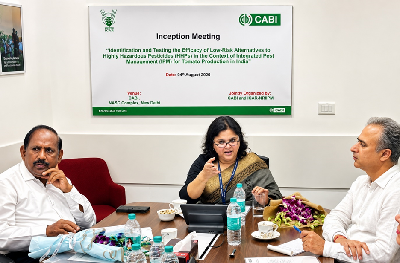
The meeting marked the formal commencement of collaborative efforts between ICAR and CABI to promote sustainable tomato production through the identification, evaluation, and promotion of safer alternatives to highly hazardous pesticides within the framework of Integrated Pest Management (IPM) for which ICAR-NRIIPM will conduct trials on “Integrated Pest Management strategies in tomato production as an alternative to highly hazardous pesticides”.
During the meeting it was deliberated that use of highly hazardous pesticides for pest management in tomato is highly health hazardous as it is also consumed raw. In her inaugural remarks, Dr Poonam Jasrotia, emphasized there is urgent need to identify and validate effective, low-risk, label-claimed chemical alternatives to highly hazardous pesticides that are currently in widespread use due to limited awareness about hazardous nature and the availability of safer options. She underscored that generating scientific evidence on safer alternatives would support informed decision-making and facilitate their adoption by farmers.
Dr Raman Thanagvelu highlighted that Integrated Pest Management offers a sustainable approach to tomato pest management by integrating non-chemical methods with need-based application of safer chemical pesticides. He further stressed that IPM modules tailored to specific pest scenarios and prevailing agro-ecological conditions can effectively manage pests while reducing dependence on highly hazardous pesticides. Dr. Manoj Chaudhary and Dr. Rekha Balodi also elaborated about the IPM module developed by ICAR-NRIIPM for tomato.
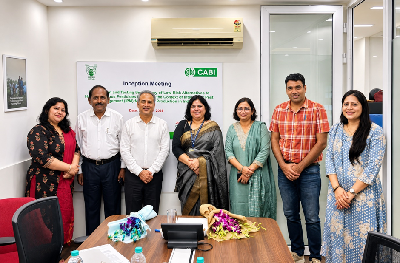
Dr Vinod Pandit outlined CABI's global initiatives for sustainable crop production and emphasized that the present collaboration would contribute significantly to the development of safer pest management strategies for tomato with potential global relevance. He noted that the outcomes of the project could serve as a model for reducing dependence on highly hazardous pesticides in vegetable production systems.
The technical components and implementation strategy of the project were presented and the participating scientists held detailed discussions on the various project modules, methodologies, field validation, stakeholder engagement, and implementation roadmap to ensure effective execution and successful achievement of the project objectives. The meeting concluded with a comprehensive discussion on future activities, timelines, and collaborative responsibilities, followed by a vote of thanks to the Chair.
(Source: ICAR–National Research Institute for Integrated Pest Management, New Delhi)



Like on Facebook
Subscribe on Youtube
Follow on X X
Like on instagram