


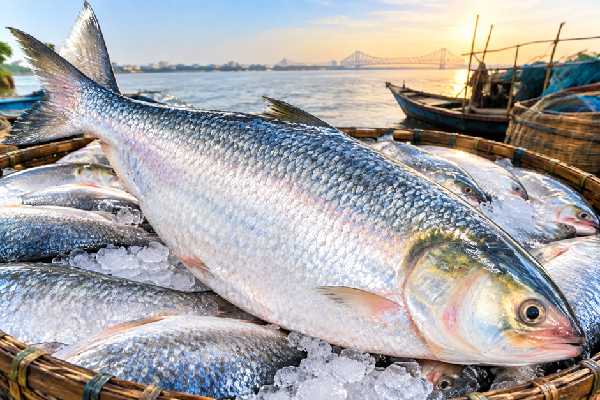
The recent movement of Indian hilsa to Bangladesh is emerging as a significant development in the regional fisheries trade, signalling strong international demand for Indian hilsa and opening new opportunities for strengthening India’s fisheries economy, particularly in West Bengal.
India has exported around 500 tonnes of hilsa to Bangladesh during the past two months, with fish traders anticipating another 150–200 tonnes of exports in the coming weeks. The development represents a notable reverse trade flow in a fish traditionally associated with movement from Bangladesh into Indian markets, reflecting changing production, availability and demand dynamics in the two neighbouring countries.
The increased demand from Bangladesh is reportedly linked to lower domestic hilsa catches, creating an opportunity for Indian producers, traders and fishery value chains to serve an established and high-value regional market. A substantial proportion of consignments has reportedly originated from Gujarat, particularly the Bharuch region, while some supplies have moved through the Howrah wholesale fish market in West Bengal.
The emerging trade is particularly important because hilsa commands strong consumer preference in Bangladesh and across eastern India. Traders report that hilsa with high roe content is attracting considerable demand in Chattogram and Sylhet, while roe is also being separated for processing and re-export to overseas markets. Some imported fish is additionally being processed into dried and salted products.
Reverse trade: a positive signal for India’s fisheries economy
The reverse movement of hilsa demonstrates that India is not only a major consumer market for hilsa but can also emerge as a competitive supplier to neighbouring and international markets when domestic availability, quality and supply chains align with market demand.
For West Bengal, the development carries particular significance. The State has a strong cultural association with hilsa, an extensive riverine and estuarine ecosystem and an established fish marketing network centred around Kolkata and Howrah. The present trade movement therefore provides an opportunity to strengthen production, aggregation, cold-chain logistics, value addition, processing, branding and export-oriented fisheries enterprises.
“The export of Indian hilsa to Bangladesh is not merely a trade phenomenon; it is a strong market signal reflecting the exceptional consumer preference, economic value and regional demand for this iconic fish. Scientifically and strategically, it underscores the untapped potential of hilsa as a high-value fishery resource capable of contributing to food security, fisher livelihoods, domestic consumption and regional trade. For West Bengal, this presents a unique opportunity to transition from a consumption-oriented fishery to a knowledge-driven, sustainable and value-added hilsa economy through science-based stock enhancement, responsible fisheries management, post-harvest value addition and integrated market linkages. With coordinated efforts in research, conservation, value-chain development and institutional collaboration, West Bengal has significant potential to contribute to a sustainable hilsa value chain and enhance the recognition of Indian hilsa as a high-value fishery resource,” said Dr Pradip Dey, Director, ICAR-CIFRI.
Trade growth must go hand in hand with conservation
The expanding market opportunity also reinforces the need to ensure that increased commercial demand does not place additional pressure on wild hilsa stocks. Sustainable production must remain the foundation of any long-term expansion in hilsa trade.
Effective implementation of the conservation measures prescribed under the relevant West Bengal Government Gazette notification is therefore essential. Particular attention is required to minimise the capture of juvenile hilsa and protect mature and gravid brooders.
During March–May, stronger regulation of fishing in the Hooghly River can help reduce juvenile mortality. Gill nets targeting hilsa should maintain a mesh size above 90 mm to minimise the capture of undersized fish below approximately 500 g.
Protection of mature and gravid hilsa during spawning migration is equally important. Major upstream migration occurs around the period from Mahalaya to Kali Puja, while another important winter migration takes place around Holi. Appropriate seasonal restrictions during these critical periods can improve recruitment and strengthen future stocks.
Healthy rivers are the foundation of a stronger export sector
The long-term opportunity created by the reverse trade flow will depend on maintaining healthy hilsa habitats. Suitable freshwater–salinity gradients, deep-water migration corridors and unobstructed spawning routes are essential for sustaining natural recruitment “Hilsa conservation is an investment in the future of the fishery.
Maintaining suitable freshwater–salinity gradients, protecting deep-water migration corridors and establishing strategic fishing-free zones at estuarine entry points are essential for safe upstream migration of large hilsa. These measures, together with advances in breeding and seed production, can provide a strong foundation for sustainable hilsa fisheries in the Hooghly–Sundarban ecosystem,” said Dr.Ranjan Kumar Manna, HoD, ICAR-CIFRI.
The Saptamukhi, Matla, Thakuran and Herobhanga rivers in the Sundarban currently support relatively low hilsa abundance, partly due to reduced freshwater discharge and altered salinity regimes. Scientifically planned restoration of hydrological connectivity, including strategic dredging wherever feasible and environmentally appropriate, could contribute to improving habitat conditions.
As large hilsa generally migrates through deeper channels, protecting critical deep-water stretches of the Hooghly from fishing gear during migration periods could facilitate safe movement. Strategic fishing-free zones near estuarine entry points could provide additional protection during critical migration phases.
Science and technology can unlock the next phase
The growing market opportunity is being complemented by advances in hilsa research. ICAR-CIFRI, Barrackpore, with support from other ICAR Institutes like CIFE, CIBA, CIFA and NBFGR, has made significant advances in hilsa research, including non-invasive maturity determination through ultrasonography and hilsa seed production using cryopreserved milt.
These technological developments offer promising possibilities for future breeding and seed-production programmes and could eventually support the development of science-based hilsa aquaculture and stock enhancement, while reducing dependence on wild stocks.
From reverse trade to sustainable trade
The present reverse flow of hilsa from India to Bangladesh should therefore be viewed as an opportunity to build a stronger, more organised and sustainable fisheries value chain in India. For West Bengal, the development can catalyse greater attention to hilsa conservation, production enhancement, scientific fisheries management, value addition, processing, branding and export infrastructure. The message is clear: the reverse trade flow is not simply a shift in the direction of hilsa movement—it is a market signal. It demonstrates the potential of Indian hilsa to compete in high-value regional markets and creates an opportunity to transform the fish’s iconic cultural identity into a stronger economic asset.
With science-based fisheries management, habitat restoration, protection of spawning stocks, responsible fishing and continued technological innovation, West Bengal can pursue increased hilsa production and trade without compromising the ecological integrity of the Ganga–Hooghly–Sundarban system.
A stronger hilsa economy must begin with a stronger hilsa ecosystem—and the current reverse trade flow provides a timely opportunity to build both together.



Like on Facebook
Subscribe on Youtube
Follow on X X
Like on instagram