


30 June 2026 Motihari, Bihar
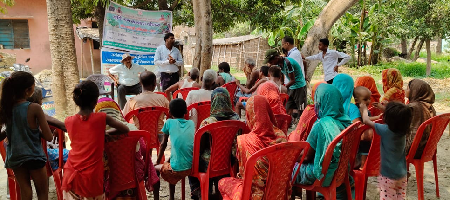
As part of the nationwide Khet Bachao Abhiyan–2026, the ICAR–Mahatma Gandhi Integrated Farming Research Institute, Motihari, in collaboration with the Department of Agriculture, Government of Bihar, organised a farmer awareness programme on scientific nutrient management and fruit-based Integrated Farming Systems (IFS) at Dhobia Tola, Chargahan Panchayat, Turkaulia Block, East Champaran district, Bihar.
The programme was jointly conducted under the Khet Bachao Abhiyan and the Bihar Krishi Jan Kalyan Chaupal, a farmer outreach initiative of the Department of Agriculture and ATMA, Government of Bihar, to enhance farmers' awareness of sustainable agriculture, soil health management, climate-resilient technologies, and scientific crop production practices.
Recognising the importance of fruit-based farming systems in the region, where mango, litchi, and papaya are major income-generating crops, the programme focused on balanced fertilizer use, soil health management, micronutrient nutrition, organic nutrient recycling, and integrated nutrient management strategies for improving orchard productivity, fruit quality, and long-term sustainability.
Farmers were encouraged to adopt soil-test-based nutrient management and integrate recommended fertilizer doses with farmyard manure (FYM), biofertilizers, organic manures, and micronutrients to improve soil fertility, enhance nutrient-use efficiency, and sustain orchard productivity. The programme highlighted that balanced nutrition, maintenance of soil organic carbon, and correction of nutrient deficiencies are essential for achieving higher yields, better fruit quality, and improved farm profitability.
Special emphasis was placed on nutrient management in mango orchards. Farmers were advised that mature mango trees generally require about 1.5 kg nitrogen, 0.5 kg phosphorus, and 1.0 kg potassium per tree annually, along with 40–50 kg of well-decomposed FYM. It was recommended that half of the nitrogen dose, together with the full doses of phosphorus and potassium, be applied at the onset of the monsoon while integrating organic nutrient sources to improve soil health and nutrient-use efficiency. The importance of micronutrients in supporting enzyme activity, hormone synthesis, flowering, fruit set, and fruit development was also highlighted.
The programme also covered scientific nutrient management practices for litchi orchards, emphasising the need to maintain a balance between soil fertility, plant nutrition, and orchard management. Farmers were encouraged to improve soil organic carbon through the use of FYM, compost, green manuring, and biological nutrient sources to ensure sustainable fruit production.
Detailed advisories were provided on papaya cultivation and nutrient management. Farmers were informed that papaya requires approximately 10 kg FYM per plant as a basal application, followed by 50 g each of nitrogen, phosphorus, and potassium per plant at bimonthly intervals during the establishment stage. The application of biofertilizers such as Azospirillum and Phosphobacteria (20 g per plant) was recommended to enhance nutrient availability and promote root development.
For drip-irrigated papaya orchards, fertigation practices involving 13.5 g urea and 10.5 g muriate of potash per plant per week, along with periodic phosphorus application, were recommended. Farmers were also advised to undertake foliar sprays of 0.5% zinc sulphate and 0.1% boric acid during the fourth and eighth months after planting to improve plant growth and fruit yield.
The importance of maintaining good drainage in papaya orchards, particularly in the flood-prone areas of North Bihar, was highlighted. Farmers were advised to adopt integrated nutrient and disease management practices to improve orchard health, productivity, and resilience.
The programme further promoted the integration of fruit crops with livestock, vermicomposting, green manuring, crop diversification, and resource recycling as key components of fruit-based Integrated Farming Systems. These approaches can improve resource-use efficiency, enhance farm income, strengthen climate resilience, and reduce dependence on external agricultural inputs.
The programme concluded with a strong message that healthy soils, balanced nutrition, organic nutrient recycling, and integrated farming systems are fundamental to sustainable fruit production and long-term livelihood security. Farmers appreciated the practical recommendations and expressed their willingness to adopt soil-health-centred nutrient management and integrated farming practices promoted under the Khet Bachao Abhiyan.
A total of 44 farmers, including 30 men and 14 women, participated in the programme and actively interacted with scientists on nutrient management, soil health restoration, and sustainable fruit-based farming systems.
(Source: ICAR–Mahatma Gandhi Integrated Farming Research Institute, Motihari, Bihar)



Like on Facebook
Subscribe on Youtube
Follow on X X
Like on instagram