


In the foothills of the Himalayas, where farming is closely woven into the rhythm of rural life, a quiet transformation is taking place in Domat village of Kalsi block, Dehradun district, Uttarakhand. Here, an age-old knowledge of processing ginger preserved and practised by generations of farmers is emerging as a powerful source of livelihood and economic opportunity.
The story of Domat is not merely about growing ginger. It is about what happens when farmers add value to what they cultivate, combine indigenous knowledge with local ingenuity, and turn a traditional practice into an income-generating enterprise.
Kalsi block, spread across approximately 270 square kilometres in the foothills of the Himalayas, experiences a subtropical climate, with hot summers, cold winters and around 1,500 mm of annual rainfall, most of it received during the monsoon. Its fertile loamy and sandy-loam soils support a range of crops, including rice, wheat, maize and vegetables, alongside fruit cultivation and livestock rearing.
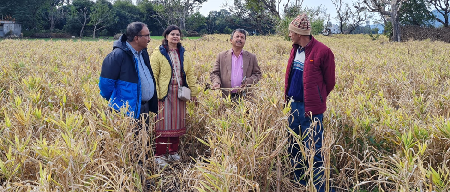
Among these crops, ginger has emerged as an important cash crop for farmers in Domat and neighbouring villages. Well suited to the local agro-climatic conditions, ginger offers farmers a high-value agricultural option with demand extending across culinary, medicinal and other applications. More importantly, the community has developed its own distinctive ways of processing and preserving the crop locally known as Panjhol and Sukhjhol.
The Value Beyond the Harvest
For the farmers of Domat, the ginger harvest does not mark the end of the production cycle. It marks the beginning of an indigenous value-addition process.
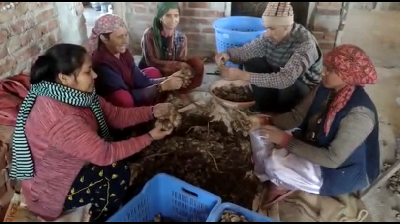
Freshly harvested ginger is first sorted to remove unripe, damaged or diseased rhizomes. The good-quality rhizomes are graded according to size and appearance before being washed thoroughly two or three times. The cleaning is done carefully by hand to prevent damage to the rhizomes, as cuts and bruises can lead to decay and shrinkage.
What follows is the most distinctive part of the process the transformation of fresh ginger into dried ginger, locally referred to as ‘Gilti’.
Two indigenous methods are traditionally followed by the community: Sukhjhol and Panjhol. While both methods involve similar initial steps of harvesting, cleaning, sorting and grading, they differ primarily in the treatment of the ginger skin before drying.
Sukhjhol: Tradition Meets Local Innovation
According to the villagers, Sukhjhol is preferred for its relatively lower labour requirement. Unlike Panjhol, the ginger does not need to be peeled before drying.
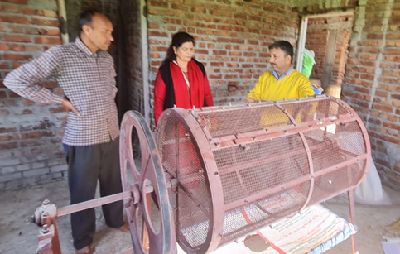
After washing and grading, the ginger is initially kept in shaded areas for preliminary drying. It is then processed using a rotary drying machine developed locally by the villagers themselves.
This simple yet ingenious machine represents the community's ability to innovate using locally available resources. The horizontal, rotary drum-shaped machine is designed with perforations that allow water released from the ginger to drain out as the drum rotates rapidly.
The machine is available in two forms one operated manually and another powered by a 2 HP motor. The motorised version increases the speed and processing capacity, while reducing the physical effort involved in the operation.
The machine can process approximately 1 quintal of ginger per hour, making it not only a time-saving innovation but also a drudgery-reducing technology for the farmers.
An additional advantage is that the process helps separate the outer layer of the ginger. This material is collected separately and can subsequently be used in the preparation of ginger spice powder, ensuring better utilisation of the produce and minimising wastage.
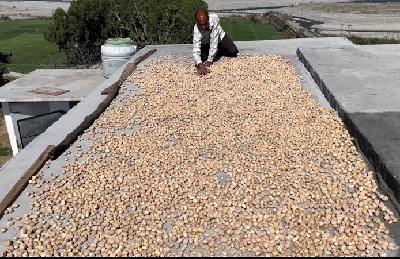
Following machine processing, the ginger is exposed to sunlight for further drying. Once adequately dehydrated, the finished product is locally known as ‘Gilti’, which is then marketed by the farmers.
Panjhol: Preserving an Indigenous Practice
The Panjhol method follows the same basic sequence of washing, sorting and grading but involves one important additional step peeling the ginger before drying.
The mature rhizomes are gently scraped using sharp knives to remove the outer skin. The farmers take care not to scrape too deeply, thereby protecting the oil-rich cells beneath the skin. Peeling is generally limited to the flatter surfaces, while the skin between the fingers of the rhizome is largely retained.
The peeled ginger is then subjected to the same locally developed drying process. After preliminary drying in shaded conditions, it is processed through the rotary machine and subsequently dried further.
The final dried product, or ‘Gilti’, is obtained after the ginger is sufficiently dehydrated. Depending on local temperature and humidity conditions, the drying period may vary.
The community's reliance on air circulation and natural drying makes Panjhol a low-cost and environmentally conscious traditional processing practice, requiring no sophisticated external energy inputs during the natural drying stages.
From Indigenous Knowledge to Economic Empowerment
The real significance of Panjhol and Sukhjhol lies not only in the uniqueness of the processing methods but in their economic impact on the farming community.
A study undertaken by the Krishi Vigyan Kendra (KVK) to assess the impact of ginger cultivation and processing in Domat revealed a remarkable picture of rural enterprise.
The village comprises nearly 100 families, of which around 80 families have adopted ginger as a cash crop and are engaged in its processing. Both Panjhol and Sukhjhol methods are used to produce dried ginger or ‘Gilti’, which is subsequently marketed in nearby mandis.
According to the farmers, around 25,000 kg of good-quality dried ginger is sold from the village, fetching approximately ₹3,000–₹5,000 per kg. The second- and third-grade produce also finds a market, with prices ranging from approximately ₹1,500 to ₹2,000 per kg.
The community estimates that the overall annual earnings from dried ginger are approximately ₹8 crore.
For a single village and a single crop, this represents a significant economic opportunity.
The experience of Domat demonstrates how value addition at the farm and village level can substantially enhance the economic potential of agricultural produce. Instead of selling ginger only as a fresh commodity, farmers process it into a higher-value, storable product, enabling them to access additional market opportunities.
A Technology Born from the Community
Perhaps the most inspiring aspect of the Domat story is that the technological intervention did not originate from an industrial production unit. It emerged from within the farming community itself.
The locally fabricated rotary drying machine reflects a practical understanding of the challenges faced by farmers—particularly the time, labour and physical effort required to process large quantities of ginger.
Its manual and motorised versions offer flexibility according to the scale and resources of individual farmers. At the same time, the machine's ability to facilitate drying and separation adds efficiency to a process that was traditionally labour-intensive.
This is a compelling example of grassroots innovation, where indigenous knowledge and locally developed technology come together to create a solution suited to the community's needs.
Women at the Heart of Value Addition
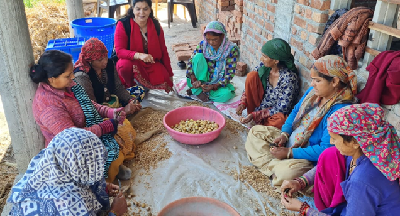
The processing of ginger also creates opportunities for greater participation of rural women. Activities such as cleaning, sorting, grading and peeling, particularly under the Panjhol method, involve considerable manual work and are traditionally undertaken by farm women.
By converting these activities into an organised value-addition chain, ginger processing has the potential to generate additional livelihood opportunities within the village while retaining a larger share of the value generated from the crop within the rural economy.
From a Village Enterprise to a Scalable Model
The experience of Domat offers a promising pathway for strengthening the ginger value chain further.
The formation of a cooperative society or Farmer Producer Organisation (FPO) could enable farmers to collectively aggregate, store and market their dried ginger. Establishing appropriate storage facilities or warehouses could allow farmers to maintain a stock of processed produce and negotiate collectively with buyers instead of selling individually.
Collective marketing could also facilitate access to better markets and improve the bargaining position of farmers. With appropriate branding, packaging and quality assurance, ‘Gilti’ could potentially be developed as a distinctive village or regional product, opening avenues for wider domestic markets and, where feasible, external markets.
The processing enterprise could also create additional local employment through requirements for machine operators, technicians, packaging workers and other support services.
A Story of Tradition, Innovation and Opportunity
The story of Domat is ultimately a story of transformation through value addition.
What begins as a humble ginger rhizome from a Himalayan foothill farm passes through the hands of farmers, traditional processing practices and a machine designed by the community itself before emerging as a marketable, storable and higher-value product.
Panjhol and Sukhjhol demonstrate that indigenous knowledge is not simply a legacy of the past—it can also be a foundation for rural enterprise in the present.
The experience of Domat shows how local resources, traditional wisdom, grassroots innovation and collective action can converge to create new economic opportunities for farming communities. With institutional support, improved market linkages, collective organisation and appropriate branding, this indigenous ginger-processing model has the potential to evolve from a successful village practice into a replicable pathway for value addition, livelihood enhancement and sustainable rural development.
In Domat, ginger is therefore much more than a crop. It is a story of farmers turning tradition into enterprise, innovation into efficiency, and a local harvest into a pathway towards greater prosperity.



Like on Facebook
Subscribe on Youtube
Follow on X X
Like on instagram