


24 June 2026, Motihari, Bihar
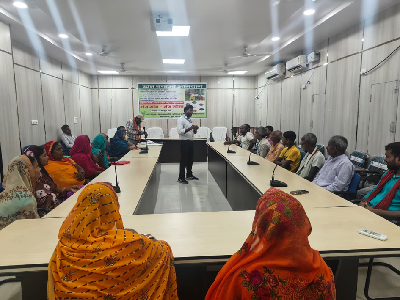
As part of the nationwide Khet Bachao Abhiyan–2026, ICAR–Mahatma Gandhi Integrated Farming Research Institute, Motihari organized a series of farmer awareness-cum-training programmes across several villages and blocks of East and West Champaran district, Bihar. The campaign focused on promoting Integrated Farming Systems (IFS), soil health restoration, balanced fertilizer use, green manuring, crop diversification, crop residue management, and climate-resilient agriculture.
The programme also served as a platform for collecting farmers’ feedback on awareness, adoption, and future requirements related to sustainable agriculture. The feedback exercise helped scientists better understand existing knowledge gaps, farmers’ priorities, and opportunities for strengthening future interventions under the Khet Bachao Abhiyan.
Under the leadership of Dr Raghavendra Singh, Director, ICAR-MGIFRI, the institute has been promoting Integrated Farming Systems as a viable strategy for improving farm income, resource-use efficiency, and resilience in the waterlogged and flood-prone agroecosystems of Bihar.
The programme highlighted the importance of crop residue retention and recycling, advising farmers to avoid residue burning due to its adverse effects on nutrient availability, soil organic carbon, soil health, and the environment. Farmers were encouraged to incorporate, compost, or recycle crop residues within integrated farming systems to enhance nutrient cycling and soil productivity.
The benefits of integrating crops, fisheries, livestock, horticulture, and other farm enterprises were emphasized to develop sustainable and profitable farming systems. Farmers were encouraged to adopt fish-based farming, goat rearing, backyard poultry, horticultural enterprises, and crop diversification to generate year-round income while minimizing production risks.
The importance of crop diversification, crop planning, and efficient utilization of farm resources was also discussed, with farmers encouraged to follow scientific crop calendars for timely sowing, efficient input use, higher cropping intensity, and improved profitability.
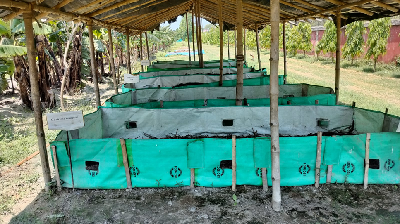
Integrated Farming Systems were presented as being based on the principle of “Recycle, Reuse and Regenerate,” where crop residues, livestock manure, pond nutrients, green manures, composts, and biofertilizers are recycled within the farm to reduce dependence on external inputs and improve sustainability. The role of summer mungbean and Sesbania (Dhaincha) in enhancing soil fertility through biological nitrogen fixation was highlighted. Summer mungbean can fix about 25–30 kg nitrogen ha⁻¹, equivalent to 55–65 kg urea ha⁻¹, while Dhaincha green manuring can contribute 50–60 kg nitrogen ha⁻¹, equivalent to 110–130 kg urea ha⁻¹. These crops help reduce fertilizer requirements while improving soil organic matter and biological activity.
The campaign also emphasized judicious fertilizer use and reducing excessive dependence on chemical inputs. Soil-test-based nutrient management was highlighted as a means of lowering fertilizer costs while improving crop productivity and profitability. The role of biofertilizers, organic manures, and eco-friendly nutrient management practices in enhancing soil biological health and nutrient-use efficiency was also discussed.
Feedback collected from farmers revealed that while awareness regarding balanced fertilizer use is increasing, many farmers still require greater understanding of soil-test-based fertilizer recommendations, Integrated Nutrient Management (INM), Soil Health Card recommendations, green manuring, biofertilizers, climate-resilient agriculture, and water conservation practices.
A significant proportion of farmers expressed interest in adopting Integrated Farming Systems, particularly fish-based farming, goat rearing, backyard poultry, horticulture, and crop-based enterprises to diversify income and reduce climate-related risks. Women farmers highlighted the need for small-scale IFS models, drudgery-reducing farm tools, and income-generating enterprises suitable for household-level implementation.
The feedback further indicated strong interest in Dhaincha cultivation, summer mungbean, vermicomposting, crop residue recycling, biofertilizers, natural farming practices, and soil testing services. Farmers appreciated the opportunity to interact directly with scientists and emphasized the need for more field demonstrations, village-level training programmes, and continuous technical guidance.
The programme witnessed the participation of 38 farmers, who actively engaged with scientists on sustainable farming solutions and future development opportunities.
(Source: ICAR–Mahatma Gandhi Integrated Farming Research Institute, Motihari, Bihar)



Like on Facebook
Subscribe on Youtube
Follow on X X
Like on instagram