


Collective action, GI authorised-user registration and FPC-based value enhancement are helping Magahi Paan farmers unlock the commercial potential of Bihar’s iconic betel leaf
For generations, the farmers of Bihar’s Magadh region have cultivated Magahi Paan, a distinctive variety of betel leaf (Piper betel) valued for its unique flavour, appearance and palatability. Yet, despite its strong traditional identity and commercial importance, farmers had limited awareness of how the product’s Geographical Indication (GI) status could be leveraged to strengthen its market identity and improve value realisation.
Magahi Paan received Geographical Indication (GI) registration on 28 March 2018, recognising its distinctive association with Bihar. However, GI registration alone does not automatically translate into greater benefits for individual growers. For farmers to make effective use of the GI identity, awareness about GI provisions, authorised-user registration, branding and collective marketing is crucial.
To bridge this gap, the ICAR-All India Co-ordinated Research Project on Medicinal and Aromatic Plants and Betelvine (AICRP-MAP&B), Islampur Centre, Bihar Agricultural University (BAU), Sabour, with technical support from ICAR-Directorate of Medicinal and Aromatic Plants Research, Anand, initiated efforts to sensitise and support Magahi Paan growers in obtaining GI authorised-user registration and strengthening collective value enhancement.
Turning a traditional identity into a collective opportunity
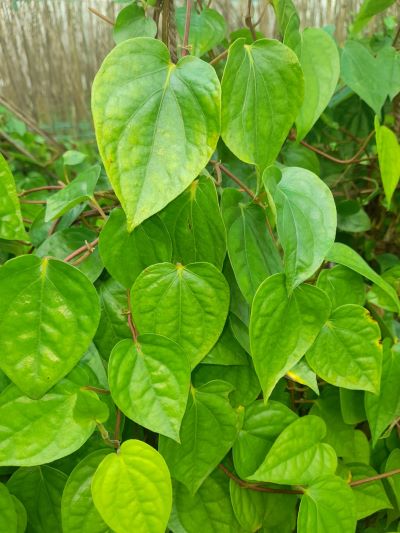
The GI Registry identifies Bihar as the geographical area for Magahi Paan. The crop is traditionally cultivated across the Magadh region, particularly in Aurangabad, Gaya, Nawada and Nalanda districts. Magahi Paan is recognised by its shiny dark-green, heart-shaped leaves, low pungency and low fibre content, which make the resulting betel quid mild, palatable and easily soluble in the mouth. The presence of eugenol and acetyl eugenol in the leaf oil contributes to its distinctive flavour.
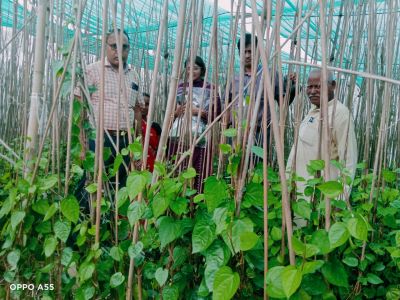
While betelvine occupies around 4,000 hectares in Bihar, Magahi Paan is cultivated on approximately 439 hectares, making the strengthening of its identity and value chain particularly important for its growers.
Betelvine is a mandate crop of the ICAR-AICRP-MAP&B, coordinated from ICAR-DMAPR, Anand. Through its technical support and farmer-oriented interventions, the programme has been working to connect scientific and institutional support with the needs of growers at the grassroots level.
A significant step in this direction came through the efforts of Shri Shiv Shankar Kumar, a progressive Magahi Paan farmer who played a key role in mobilising fellow growers and facilitating the formation of the Renu and Rajendra Magahi Paan Producer Company Limited at Dhevari village, Hisua, Nawada, Bihar.
Registered on 11 September 2023 under the Companies Act, 2013, the Farmer Producer Company (FPC) created an institutional platform through which farmers could come together for production, branding, marketing and promotion of Magahi Paan.
The collective approach also helped farmers understand that GI recognition could be more than a certification it could become a tool for establishing product identity, strengthening market linkages and creating greater visibility for the growers behind the product.
1,001 farmers take the GI route
Through sustained awareness generation, facilitation and coordination, farmers were encouraged to formally associate themselves with the registered GI product.
The initiative culminated in the registration of 1,001 Magahi Paan farmers from Nawada and Nalanda districts as GI authorised users. The GI Registry also records sizeable clusters of registered users from villages in Hisua and adjoining Magahi Paan-growing areas, reflecting the growing adoption of GI formalisation among growers.
For farmers, authorised-user registration provides a formal connection with the GI product and creates a stronger institutional foundation for collective branding and marketing. For Magahi Paan as a product, it strengthens the link between its geographical identity and the farmers who cultivate it.
Government support strengthens the value chain
Institutional support for Magahi Paan has also been reinforced through the Government of Bihar’s horticultural interventions.
Under the special horticultural crop scheme, area expansion of Magahi Paan was undertaken through FPCs in Aurangabad, Gaya, Nawada, Sheikhpura and Nalanda, with support for farmers cultivating between 100 and 500 m².
Building on these efforts, the State Government approved the Paan Development Scheme, with a total financial provision of ₹491.385 lakh for 2023–24 and 2024–25.
The 2025–26 Paan Vikas Yojana continues to support expansion of betel-leaf cultivation through FPCs and individual farmers across Aurangabad, Gaya, Nalanda, Nawada, Sheikhpura, Vaishali, Bhagalpur, Muzaffarpur, Samastipur, Munger, Darbhanga and Saran districts.
These interventions complement the GI-focused efforts by supporting both expansion of cultivation and the institutional development of the farmer base.
Better market recognition, stronger collective foundation
The impact is beginning to be reflected in the marketplace. According to the original field report, growers in the Magahi Paan production area have observed an increase in market prices, with reported prices reaching approximately ₹280–300 per dholi (200 leaves), compared with ₹120–140 per dholi in earlier years in the Varanasi and Gaya markets.
While several factors influence agricultural market prices, the reported increase points to the evolving commercial environment around Magahi Paan. More importantly, the formation of the FPC and the registration of 1,001 GI authorised users have created an institutional foundation for farmers to pursue greater collective strength in production, branding, marketing and value addition.
From tradition to enterprise
The Magahi Paan experience demonstrates how a traditional agricultural product can move beyond its historical identity towards a more organised and market-oriented value chain.
For generations, farmers have preserved the distinctive characteristics of Magahi Paan through traditional cultivation. The emerging institutional ecosystem is now helping them strengthen another equally important dimension the collective ownership of their product identity and its market potential.
With GI authorised-user registration, farmer collectivisation through an FPC, government support for area expansion and continued institutional handholding, Magahi Paan growers are gradually building the foundations for a stronger and more organised value chain.
The journey of Magahi Paan from a traditional crop to a GI-recognised agricultural identity thus represents more than the protection of a geographical name. It reflects how farmer awareness, collective action and institutional support can convert geographical identity into an opportunity for greater visibility, market participation and value creation for the growers themselves.
(Source: ICAR-Direcrtorate of Mediicnal and Aromatic Plants Research, Anand, Gujarat)



Like on Facebook
Subscribe on Youtube
Follow on X X
Like on instagram