


11 October 2026, Sirsa, Haryana
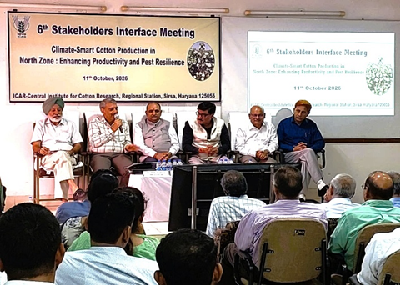
ICAR-Central Institute for Cotton Research, Regional Station, Sirsa, organised the 6th Stakeholders’ Interface Meeting on “Climate-Smart Cotton Production in North Zone: Enhancing Productivity and Pest Resilience” today. The meeting was chaired by Dr B. R. Kamboj, Vice-Chancellor, Chaudhary Charan Singh Haryana Agricultural University (CCSHAU), Hisar, and co-chaired by Dr D. K. Yadava, Deputy Director General (Crop Science), ICAR, and Dr Rajbir Singh, Deputy Director General (Agricultural Extension), ICAR.
Dr B. R. Kamboj stressed the need to develop innovative technologies and strengthen research to enhance cotton productivity and address emerging insect pests and diseases. He emphasised effective coordination between scientists and agricultural extension officers to ensure that research-based technologies reach farmers. He also highlighted the importance of farmer feedback in developing farmer-friendly technologies and noted that timely dissemination of scientific recommendations would help farmers make informed decisions and improve crop performance.
Dr Rajbir Singh highlighted various Government of India initiatives aimed at improving farmers’ livelihoods. He emphasised the need to translate scientific research into practical field-level solutions through effective extension programmes, farmer training and timely technical guidance.
Dr D. K. Yadava highlighted the importance of the National Mission on Cotton Productivity, a five-year initiative covering 2026–27 to 2030–31, with an outlay of approximately ₹5,800 crore. The mission covers 140 districts across 14 states and envisages 23.71 lakh demonstrations of improved technologies and around 28,000 farmer training programmes. Its key interventions include the promotion of high-yielding cotton varieties and hybrids resistant to insect pests and diseases, micro-irrigation, high-density planting systems, farm mechanisation and advanced crop production technologies.
He further emphasised strengthening the cotton value chain, demonstrating proven technologies in farmers’ fields and ensuring the availability of quality agricultural inputs. He also highlighted the need to curb the circulation of spurious seeds and fertilisers.
Dr S. K. Verma, Head I/c and Principal Scientist, ICAR-CICR Regional Station, Sirsa, welcomed the participants and highlighted the prevailing cotton scenario in North India, along with key challenges affecting crop production, productivity and pest resilience across the North Zone.
Dr V. N. Waghmare, Director, ICAR-CICR, Nagpur, highlighted the major constraints in cotton cultivation and emphasised the need to expand the area under cotton, improve productivity and promote farm mechanisation. He underscored the importance of disseminating and integrating technologies developed and validated by ICAR-CICR and the All India Coordinated Research Project on Cotton (AICRP on Cotton) for improving cotton production. He also stressed the implementation of research activities by partner institutes and centres under the National Mission on Cotton Productivity 2026–31.
The meeting was attended by more than 100 participants, including Dr A. S. Datt, Director of Research, Punjab Agricultural University (PAU), Ludhiana; Dr Rajbir Garg, Director of Research, CCSHAU, Hisar; Dr N. K. Sharma, Director of Research, Swami Keshwanand Rajasthan Agricultural University (SKRAU), Bikaner; Dr R. P. Sihag, Additional Agriculture Director, Government of Haryana; and the Joint Director of Agriculture (Cotton). Scientists, officials from Krishi Vigyan Kendras (KVKs) and State Departments of Agriculture, representatives of private-sector seed companies, ginners and input dealers, and farmers from Haryana, Punjab and Rajasthan also participated in the meeting.
(Source: ICAR-Central Institute for Cotton Research, Nagpur)



Like on Facebook
Subscribe on Youtube
Follow on X X
Like on instagram