

11 November 2026, Motihari, Bihar
ICAR–Mahatma Gandhi Integrated Farming Research Institute, Motihari, Bihar, organized a multi-village farmer awareness and technical advisory programme covering four villages Chintamanpur, Mahuava, Jamunia and Pipradeeh—in Piprakothi and Chakia blocks of East Champaran district today. The programme was conducted as part of Janjatiya Gaurav Pakhwada–2026, being observed from 1 to 15 November to commemorate the 151st birth anniversary of Bhagwan Birsa Munda. The programme aimed to strengthen farmers' technical knowledge regarding scientific wheat sowing, Rabi crop management, post-harvest management of rice and integrated farming systems (IFS), with particular emphasis on sustainable agricultural practices, resource-use efficiency and improved farm livelihoods.
During the village visits, farmers were sensitized to the importance of timely wheat sowing following rice harvesting to achieve optimum crop establishment and productivity. Technical guidance covered improved wheat varieties, quality seed selection, seed treatment, appropriate seed rate, sowing depth, balanced fertilizer application and irrigation scheduling. Farmers were also encouraged to adopt resource-conserving technologies, including zero-tillage wheat establishment, wherever suitable, to reduce cultivation costs and improve input-use efficiency.
Special emphasis was placed on scientific post-harvest management of rice, including proper drying, cleaning, safe grain storage and effective utilization of crop residues. Farmers were advised to avoid open-field burning of rice straw and instead adopt suitable residue-management practices, such as mulching, incorporation and recycling through composting. The importance of timely field preparation after rice harvesting for successful establishment of subsequent Rabi crops was also highlighted.
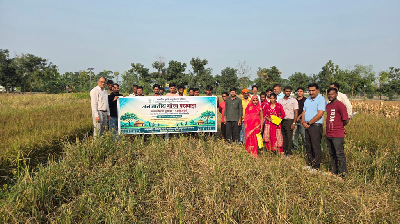
Farmers were introduced to the benefits of integrated farming systems (IFS) through the integration of crop production with livestock, horticulture and other suitable farm enterprises. Discussions focused on efficient recycling of farm resources, improved soil health, crop diversification, nutritional security and the potential of integrated farming approaches to strengthen the resilience and profitability of small and marginal farming households.
Dr Raghavendra Singh, Director, ICAR–MGIFRI, emphasized the importance of extending scientific agricultural technologies to farmers through village-level awareness and capacity-building programmes. He highlighted that timely Rabi crop establishment, improved post-harvest management, conservation of crop residues and adoption of integrated farming systems are essential for improving agricultural productivity, reducing cultivation costs and ensuring sustainable livelihoods. He further underscored that Janjatiya Gaurav Pakhwada provides an important platform to honour the legacy of Bhagwan Birsa Munda while strengthening inclusive agricultural development through scientific knowledge, technology dissemination and farmer empowerment.
The programme facilitated farmer–scientist interaction and provided an opportunity to address field-level challenges related to Rabi crop cultivation, rice residue management and farm diversification. The initiative reaffirmed ICAR–MGIFRI's commitment to sustainable agriculture, natural resource conservation and strengthening rural livelihoods through location-specific scientific interventions.
(Source: ICAR–Mahatma Gandhi Integrated Farming Research Institute, Motihari, Bihar)