


30 June 2026, Motihari, Bihar
As part of the nationwide Khet Bachao Abhiyan–2026, ICAR–Mahatma Gandhi Integrated Farming Research Institute, Motihari organized a farmer awareness-cum-training programme on scientific papaya cultivation in East Champaran and West Champaran districts of Bihar. The programme aimed to promote soil-health-centered orchard management, balanced nutrient use, integrated farming systems, and scientific crop management for enhancing papaya productivity, fruit quality, and farmers' profitability.
During the programme, scientists highlighted the objectives of the Khet Bachao Abhiyan and emphasized that papaya is one of the most profitable fruit crops as it starts bearing fruits within 8–10 months after planting and continues production for 2–3 years. Farmers were encouraged to adopt scientific production technologies to maximize productivity while maintaining long-term soil fertility.
Scientists explained that papaya performs best under temperatures of 22–35°C, annual rainfall of 1000–1500 mm, and well-drained sandy loam to loam soils with a soil pH of 6.0–7.5. Farmers were advised to avoid waterlogging, as papaya is highly sensitive to excess soil moisture and root diseases. Popular cultivars recommended for the region included Red Lady, Pusa Delicious, Pusa Dwarf, Pusa Nanha, Ranchi Dwarf, and suitable Taiwan hybrid cultivars.
Scientific orchard establishment practices were demonstrated during the technical session. Farmers were advised to plant papaya during June–July under eastern Indian conditions at a spacing of 2.0 × 2.0 m, while 1.8 × 1.8 m spacing may be adopted under high-density planting systems where appropriate. Planting pits of 60 × 60 × 60 cm should be prepared and filled with 15–20 kg well-decomposed farmyard manure (FYM), 1 kg neem cake, 250 g single super phosphate, and 50 g Trichoderma mixed with FYM to improve soil health and reduce soil-borne diseases.
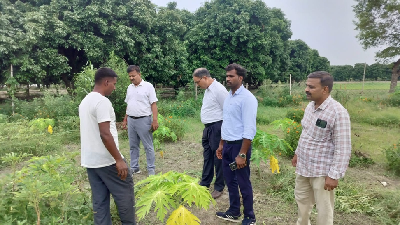
Scientists emphasized the importance of balanced nutrient management for sustaining productivity. Farmers were advised to apply 250 g nitrogen (N), 250 g phosphorus (P₂O₅), 500 g potassium (K₂O), and 15–20 kg FYM per plant annually, preferably in 6–8 split applications throughout the growing season. They also recommended integrating 50 g Azotobacter, 50 g phosphate-solubilizing bacteria (PSB), and 2–3 kg vermicompost per plant to enhance nutrient availability, improve soil microbial activity, and increase fertilizer-use efficiency.
Scientists stressed that soil testing should be the first step before fertilizer application. Farmers were encouraged to integrate organic manures, biofertilizers, crop residue recycling, green manuring, and chemical fertilizers based on soil-test recommendations. Research has consistently shown that combining the recommended NPK dose with biofertilizers such as Azotobacter, Azospirillum, and PSB significantly improves plant growth, nutrient uptake, fruit yield, and fruit quality compared with the use of chemical fertilizers alone.
Farmers were advised to irrigate papaya every 5–7 days during summer and 10–15 days during winter, while adopting drip irrigation wherever possible to improve water-use efficiency. Scientists also recommended maintaining weed-free basins and applying 5–10 cm thick organic mulch to conserve soil moisture, suppress weeds, and improve soil organic carbon.
The programme also emphasized eco-friendly pest and disease management. Farmers were advised to use healthy, virus-free seedlings and immediately rogue out plants infected with Papaya Ring Spot Virus (PRSV) while controlling aphid vectors to minimize disease spread. For managing stem and root rot, emphasis was placed on maintaining good drainage and applying Trichoderma or recommended fungicides whenever necessary. To control fruit fly infestation, scientists recommended installing methyl eugenol traps and regularly collecting and destroying infested fruits.
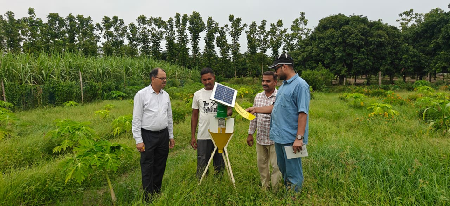
Scientists further advised harvesting papaya fruits when 25–30% of the peel turns yellow for distant markets and 50–75% yellow for local markets to obtain better fruit quality and market value. Farmers were informed that adopting scientific management practices can produce 60–100 tonnes of fruits per hectare, while high-yielding hybrids under intensive management may yield 100–150 tonnes per hectare.
The programme concluded with a strong message that healthy soil, balanced nutrition, good drainage, efficient irrigation, integrated pest management, and scientific orchard management are the key pillars of profitable and sustainable papaya cultivation. Farmers appreciated the practical recommendations and expressed their willingness to adopt soil-test-based nutrient management and integrated horticultural practices under Khet Bachao Abhiyan–2026.
The programme reaffirmed ICAR-MGIFRI's commitment to promoting climate-resilient fruit production systems through scientific advisories, farmer capacity building, and sustainable soil health management across Bihar.
(Source: ICAR–Mahatma Gandhi Integrated Farming Research Institute, Motihari, Bihar)



Like on Facebook
Subscribe on Youtube
Follow on X X
Like on instagram