


30 June 2026, Motihari, Bihar
As part of the nationwide Khet Bachao Abhiyan–2026, ICAR–Mahatma Gandhi Integrated Farming Research Institute, Motihari, organized a farmer awareness-cum-training programme on soil health management, balanced fertilizer use, and the importance of summer mungbean cultivation for farmers from various villages of East Champaran district, Bihar.
The programme centered on the campaign message, "Small Acts, Big Impact: Test Soil Before You Invest," emphasizing that soil testing should be the first step before purchasing fertilizers and other agricultural inputs. Participants were encouraged to adopt soil-test-based nutrient management and integrate legumes such as mungbean into cropping systems to improve soil fertility, enhance nutrient-use efficiency, reduce fertilizer requirements, and promote sustainable agricultural production.
Addressing the gathering, Dr Raghavendra Singh, Director, ICAR-MGIFRI, highlighted the importance of soil-test-based nutrient management and the inclusion of legumes such as mungbean in cropping systems for improving soil fertility, enhancing nutrient-use efficiency, reducing fertilizer requirements, and promoting sustainable agricultural production.
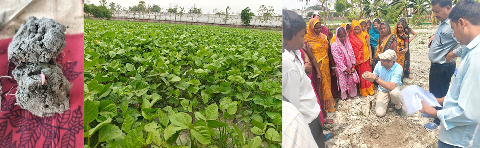
An interactive session enabled farmers to discuss prevailing agricultural practices and field-level challenges. A practical hands-on demonstration on scientific soil sampling was conducted, covering the correct methods of soil sample collection, processing, labeling, and submission to soil testing laboratories. Farmers were sensitized to the importance of obtaining accurate soil test reports for making informed fertilizer management decisions.
The programme also highlighted the need for the judicious use of fertilizers and reducing excessive dependence on chemical inputs. Participants learned how soil-test-based nutrient management can lower input costs while improving crop productivity and farm profitability. Emphasis was also placed on the role of biofertilizers and eco-friendly nutrient management practices in enhancing soil biological health and reducing reliance on chemical fertilizers.
A special field demonstration on mungbean root nodulation showcased the role of nitrogen-fixing root nodules in legumes. Farmers observed how these naturally occurring nodules contribute biologically fixed nitrogen to the soil, improve soil fertility, and reduce fertilizer requirements for subsequent crops. The demonstration reinforced the importance of incorporating legumes into cropping systems for sustainable soil health management. Scientists also highlighted the adverse effects of crop residue burning and demonstrated sustainable residue management practices alongside the principles of natural farming and Integrated Nutrient Management (INM).
The programme promoted the principles of balanced nutrient management based on the 4R approach—Right Source, Right Rate, Right Time, and Right Method of fertilizer application. Farmers were encouraged to adopt integrated nutrient management practices by combining chemical fertilizers with biofertilizers, organic manures, green manuring, crop residue recycling, and legume-based cropping systems to improve soil health, enhance nutrient-use efficiency, and ensure long-term agricultural sustainability.
A total of 46 participants, including 15 male farmers and 31 women farmers/Jeevika Didis, attended the programme and actively interacted with scientists on sustainable soil and nutrient management practices. The programme reaffirmed ICAR–MGIFRI's commitment to promoting science-based, climate-resilient, and resource-efficient farming practices under the Khet Bachao Abhiyan–2026.
(Source: ICAR–Mahatma Gandhi Integrated Farming Research Institute, Motihari, Bihar)



Like on Facebook
Subscribe on Youtube
Follow on X X
Like on instagram