


10 February 2026, New Delhi
A delegation from Australian Centre for International Agricultural Research (ACIAR), Canberra, Australia, visited ICAR–Indian Agricultural Research Institute today. ACIAR, an agency under Australia’s foreign aid program, supports research-for-development initiatives aimed at enhancing agricultural productivity, sustainability, and food system resilience in partner countries. Collaborative agricultural research between Australia and India began in 1983 and was further strengthened with the signing of a Memorandum of Understanding with ICAR in 1996.
Dr. Leigh Vial, Research Program Manager – Crops of ACIAR held a brief but substantive meeting with Ch Srinivasa Rao, Director, ICAR–IARI, along with Dr. (Mrs) Pratibha Singh, Regional Manager (South Asia), ACIAR, New Delhi.
During the meeting, discussions focused primarily on two major aspects:
(i) Ongoing ACIAR-supported projects in Bihar and West Bengal and exploring opportunities to expand collaborative work in Odisha, in partnership with locally positioned ICAR institutes, State Agricultural Universities, and non-profit organizations, with ICAR–IARI envisaged as the lead institution for bilateral ICAR–ACIAR translational research.
(ii) prioritization of key thematic areas for future collaboration with IARI, including adaptive research for water-stressed environments, targeted technologies to enhance acreage and production of oilseed and pulse crops, crop diversification, precision agriculture, and demand-driven solutions for sustainable agri-food systems.
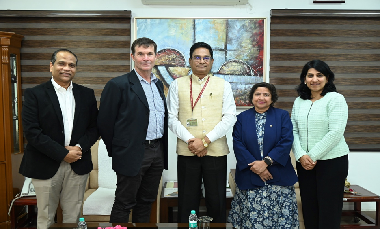
Speaking on the occasion, Dr. Ch. Srinivasa Rao stated that the long-standing partnership between ICAR and ACIAR has significantly contributed to strengthening agricultural research and innovation systems in India. “Our collaboration with ACIAR has always been science-driven and development-oriented, with a clear focus on translating research outputs into field-level impact,” he said.
Dr. Rao emphasized the need to address emerging challenges such as water scarcity, climate variability, and declining natural resources through joint, adaptive research approaches. “There is a strong need to prioritize water-stress environments, promote diversification towards oilseeds and pulses, and integrate precision agriculture tools so that technological advancements reach the last mile and generate tangible benefits for farmers,” he noted.
He further highlighted that ICAR–IARI, with its strong national and regional linkages, is well-positioned to lead multi-institutional, bilateral initiatives involving ICAR institutes, State Agricultural Universities, and development partners. “The focus should be on demand-driven, farmer-centric solutions that strengthen resilience of agri-food systems while ensuring sustainability and profitability,” Dr. Rao added.
Following the meeting, the delegation visited advanced research facilities at ICAR–IARI, including Drone Remote Sensing, Drone Robotics, and Big Data Analytics laboratories at the Division of Agricultural Physics, as well as the Nanaji Deshmukh National Plant Phenomics Centre. The visit provided an overview of cutting-edge digital and phenomics-based technologies being developed to support precision agriculture and climate-smart crop management. The visit reinforced the shared commitment of ACIAR and ICAR–IARI to deepen Indo–Australian cooperation in agricultural research for development, with a focus on innovation, sustainability, and improved livelihoods for farming communities.
(Source: ICAR–Indian Agricultural Research Institute, New Delhi)



Like on Facebook
Subscribe on Youtube
Follow on X X
Like on instagram