


25 June 2026, Motihari, Bihar
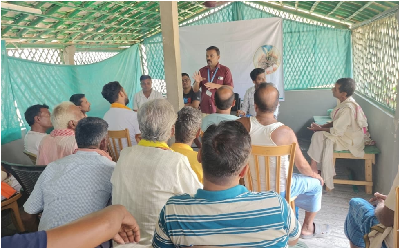
As part of the nationwide Khet Bachao Abhiyan–2026, scientists from ICAR–Mahatma Gandhi Integrated Farming Research Institute, Motihari, conducted a farmer awareness-cum-training programme at Chintamanpur village, Chakia Block, East Champaran district, Bihar. The programme focused on promoting scientific soil health management, balanced nutrient use, eco-friendly pest management, and sustainable orchard production systems for enhancing farm profitability and long-term agricultural sustainability.
The participants were sensitized on the importance of soil testing as the basis for fertilizer application. They were advised to avoid indiscriminate use of fertilizers, as excessive and imbalanced application not only increases cultivation costs but also disrupts soil nutrient balance and adversely affects long-term soil productivity.
Farmers were encouraged to adopt soil-test-based nutrient management and integrate chemical fertilizers with organic sources such as farmyard manure (FYM), vermicompost, green manuring, crop residue recycling, and biofertilizers. Emphasis was placed on the role of these integrated approaches in improving soil organic carbon, enhancing soil structure, increasing nutrient availability, and improving the water-holding capacity of soils.
Special attention was given to nutrient management in mango and litchi orchards, two important fruit crops of the region. Farmers were advised to apply fertilizers in circular trenches beneath the canopy rather than near the trunk for better nutrient uptake. For mango orchards, balanced application of FYM along with recommended doses of nitrogen, phosphorus, and potassium was emphasized, while excessive nitrogen use was discouraged because it promotes vegetative growth at the expense of flowering and fruiting.
For litchi orchards, scientists recommended application of FYM, phosphorus, and potash after harvest, while nitrogen should be applied in split doses to improve N-use efficiency. Farmers were also encouraged to use organic amendments such as neem cake and karanj cake, wherever available, for improving soil health and reducing soil-borne pest incidence.
The participants were sensitized on the importance of soil and water conservation practices, including proper land levelling, strengthening of field bunds, and in-situ rainwater conservation. They were also advised against the repeated and excessive use of rotavators, as continuous shallow tillage can lead to the formation of hard-pan layers below the plough zone, restricting root growth, reducing water infiltration, and limiting nutrient uptake by crops.
During the pest management session, emphasis was placed on eco-friendly approaches for managing pests and diseases in field crops and orchards. Farmers were encouraged to adopt Integrated Pest Management (IPM) practices such as regular field monitoring, timely pest identification, use of neem-based formulations, botanical extracts, bio-pesticides, and conservation of beneficial insects.
For mango and litchi orchards, the importance of orchard sanitation, pruning of infested branches, removal of pest-affected plant parts, and the use of biological control measures was highlighted to reduce pest pressure while minimizing dependence on chemical pesticides.
The scientists also interacted extensively with farmers on issues related to nutrient deficiencies, declining orchard productivity, waterlogging, soil compaction, organic manure use, and pest management challenges. Location-specific recommendations were provided to address these concerns through practical and cost-effective interventions.
The programme concluded with a strong message that healthy soils, balanced nutrition, organic matter management, eco-friendly pest control, and conservation-based farming practices are essential for sustaining crop and orchard productivity in Bihar.
Farmers appreciated the scientific guidance and expressed their willingness to adopt soil-health-centered nutrient management, integrated pest management, and resource-conservation practices promoted under the Khet Bachao Abhiyan–2026.
The programme strengthened farmer awareness on sustainable agriculture and reinforced the importance of protecting soil health as the foundation for productive, profitable, and climate-resilient farming systems.
A total of 29 farmers, including 22 male and 7 female participants, actively participated and interacted with scientists on issues related to soil fertility, orchard management, nutrient deficiencies, pest management, and water conservation.
(Source: ICAR–Mahatma Gandhi Integrated Farming Research Institute, Motihari, Bihar)



Like on Facebook
Subscribe on Youtube
Follow on X X
Like on instagram