


22 June 2026, North 24 Parganas, Barrackpore
In a significant breakthrough for inland fisheries conservation and rural livelihoods, the ICAR–Central Inland Fisheries Research Institute, Barrackpore, successfully demonstrated the restoration of high-value indigenous catfish populations in the Chamta Wetland through a science-based fisheries enhancement programme under its collaborative project with WorldFish.
The achievement was showcased during a Fish Harvest Mela and Scientist–Fisher Interaction Programme held at Chamta Wetland, where 387 kg of indigenous catfish (Mystus cavasius) were harvested after a six-month scientific pen culture programme. Fish stocked at an average weight of 2.28 g reached an average harvest weight of 33.6 g, reflecting high survival and excellent growth before being released into the wetland for stock enhancement and biodiversity conservation.
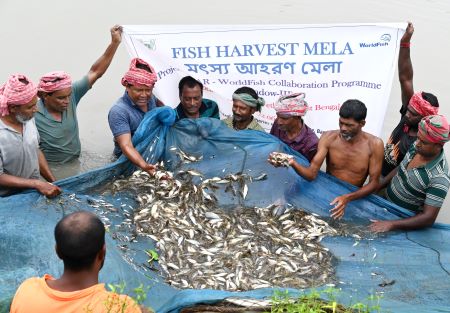
Addressing the gathering, Dr Pradip Dey, Director of ICAR-CIFRI asserted that science-driven restoration of indigenous fisheries is no longer just a conservation initiative but a strategic development imperative, capable of simultaneously revitalizing degraded wetlands, enhancing fishers' incomes, strengthening food and nutritional security, and safeguarding India's rich aquatic biodiversity for future generations. He further emphasized that such integrated, science-based interventions are closely aligned with the vision of Viksit Bharat @2047, promoting sustainable livelihoods, ecological resilience, and a vibrant blue economy through innovation, community participation, and responsible natural resource management. Dr. Dey noted that by harmonizing scientific research with grassroots implementation, India can build climate-resilient aquatic ecosystems that contribute significantly to inclusive economic growth, environmental sustainability, and the nation's long-term developmental aspirations.
Shri Pronay Bala, Manager of the Chamta Fishermen Cooperative Society, said the scientific intervention has not only improved fishers' incomes but also helped revive valuable native fish populations in the wetland.
The initiative marks a major milestone in the ecological restoration of two premium indigenous catfish species Mystus cavasius and Mystus tengara. Under the innovative strategy, fish seed were first reared in protected pen enclosures before being released into the open wetland, significantly improving their survival and establishment in the natural ecosystem.
ICAR-CIFRI provided end-to-end technical support, including scientific pen construction using HDPE poles and predator-proof nets, regular water and soil quality monitoring, fish health management, and feeding with nutritionally balanced Cagegrow floating feed. Local fishers were trained in scientific feeding, pen maintenance and monitoring, enabling active community participation in the conservation effort.
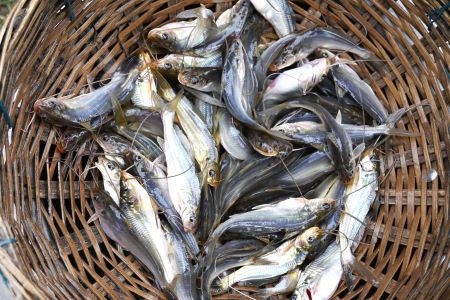
Beyond biodiversity restoration, the intervention has created substantial economic opportunities for wetland-dependent communities. While Mystus tengara commands more than four times the market price of Indian Major Carps, Mystus cavasius fetches almost three times higher value, offering significantly improved returns to local fishers.
The Chamta model is being viewed as a scalable example of community-led, science-backed inland fisheries management that integrates biodiversity conservation with sustainable livelihood generation, offering a promising roadmap for restoring small indigenous fish species across India's inland aquatic ecosystems.
(Source: ICAR–Central Inland Fisheries Research Institute, Barrackpore, Kolkata)



Like on Facebook
Subscribe on Youtube
Follow on X X
Like on instagram