

Mrs. Rajeshwari, a 38-year-old M.Sc. graduate in Botany from Wandoor village in South Andaman, has emerged as a successful rural poultry entrepreneur through the scientific interventions, capacity building, and continuous technical support provided by ICAR–Central Island Agricultural Research Institute, Sri Vijaya Puram. Her journey from a novice poultry keeper to a thriving agripreneur stands as a remarkable example of how scientific knowledge and institutional support can transform rural livelihoods.
In 2023, aspiring to create a sustainable source of self-employment, Mrs. Rajeshwari approached ICAR-CIARI for guidance in poultry farming. At the time, she had no prior experience in scientific poultry management and maintained only five indigenous birds under a traditional backyard system, primarily for household consumption. Recognizing her enthusiasm and potential, the institute enrolled her in a skill development programme on scientific rural poultry farming and provided hands-on training along with continuous technical support.
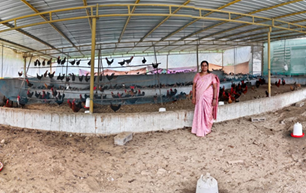
The training equipped her with practical knowledge on scientific poultry housing, flock management, health care, vaccination, feed formulation, and enterprise planning. As her confidence and skills grew, she gradually expanded her small backyard unit into a more organized rural poultry enterprise. Throughout this period, ICAR-CIARI closely monitored her progress, provided regular technical guidance, and motivated her to scale up her operations. She subsequently received advanced training on brooder-grower-breeder management, hatchery operations, disease prevention, and scientific scheduling of production activities to ensure uninterrupted output and year-round income generation.
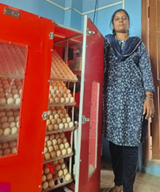
With sustained technical support from the institute, Mrs. Rajeshwari successfully established a semi-intensive rural poultry unit integrated with a mini-incubator having a setter capacity of 2,500 eggs. She initially reared 2,400 birds scientifically and gradually developed a self-sustaining breeder flock system. From the fifth month onwards, she maintained around 550 birds as parental stock for continuous chick production while simultaneously rearing nearly 1,200 birds for meat production and sale.
Today, her breeder flock produces approximately 3,600 eggs every month, of which around 2,500 eggs are utilized for hatching. By adopting improved incubation techniques and scientific health management practices, she consistently achieves nearly 80 percent hatchability, producing about 2,000 chicks every month. This integrated production model ensures a continuous supply of chicks, meat birds, and table eggs, enabling regular income generation throughout the year.
The economic performance of her enterprise highlights the viability of scientific rural poultry farming under island conditions. At present, Mrs. Rajeshwari markets approximately 600 kilograms of live poultry meat, 600 chicks, and 1,100 table eggs every month. The integrated poultry production system generates an estimated monthly net profit of about ₹1.91 lakh with a benefit-cost ratio of 2.02, clearly demonstrating the profitability and sustainability of the enterprise.
Beyond financial success, Mrs. Rajeshwari’s achievement has become a source of inspiration for rural communities across the Andaman and Nicobar Islands. Her transformation from a beginner in poultry farming to a successful entrepreneur has encouraged many rural youth and farm women to explore scientific poultry farming as a viable avenue for self-employment and income generation.
Her story is a testament to the transformative impact of scientific interventions, skill development, and dedicated institutional support. It demonstrates how educated rural youth can successfully harness modern agricultural technologies to build profitable enterprises while contributing to local employment and economic development.
The success of Mrs. Rajeshwari exemplifies ICAR-CIARI’s commitment to translating research and extension efforts into tangible livelihood opportunities. By empowering aspiring entrepreneurs through knowledge, technology, and continuous mentorship, the institute is helping create a new generation of rural agripreneurs and promoting sustainable poultry-based enterprises in the island ecosystem.
(Source: ICAR-Central Island Agricultural Research Institute, Sri Vijaya Puram, Andaman & Nicobar Islands)



फेसबुक पर लाइक करें
यूट्यूब पर सदस्यता लें
X पर फॉलो करना X
इंस्टाग्राम पर लाइक करें