

Delivers 10–20 Quintals per Acre in Just 90 Days under Diverse Growing Conditions
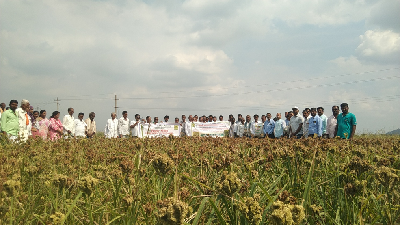
A field day on the high-yielding, early-maturing finger millet variety VL Mandua 400, developed by ICAR–Vivekananda Parvatiya Krishi Anusandhan Sansthan, Almora, was organized at Ujjaini village, Vijayanagara district, Karnataka in collaboration with National Seed Corporation, Davangere. The field day provided an opportunity to showcase the remarkable field performance and growing popularity of VL Mandua 400 among farmers in Karnataka.
Despite severe drought conditions during the ongoing El Niño-affected season, farmers cultivating VL Mandua 400 under rainfed conditions, without any irrigation, are harvesting approximately 10 quintals of grain per acre in just 90 days. Farmers having access to assured irrigation are reporting yields of nearly 20 quintals per acre. These impressive results are particularly significant when compared with other popular, long-duration finger millet varieties grown in the region, which generally require around five months to mature. VL Mandua 400 is enabling farmers to harvest higher grain yields within a substantially shorter growing period, offering them an opportunity to reduce crop duration, minimize exposure to climatic risks and potentially accommodate additional crops in their farming systems.
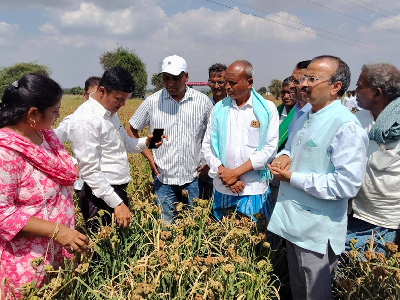
Besides its impressive grain productivity, the variety produces a substantial quantity of good-quality stover, providing farmers with an additional source of income and valuable fodder for livestock. Its early maturity, high grain yield, good fodder productivity and adaptability to moisture-stressed conditions are making it an increasingly preferred choice among farmers. The variety has already expanded to approximately 70 hectares in Karnataka, reflecting its growing acceptance and potential for wider dissemination across the state.
Addressing the farmers, Dr Lakshmi Kant, Director, ICAR-VPKAS, Almora, applauded the farming community and NSC Davangere for the outstanding adoption and dissemination of VL Mandua 400. He appreciated the farmers for recognizing the advantages of early-maturing, climate-resilient varieties and urged them to adopt other recently released early-maturing varieties developed by the institute with similar enthusiasm.
The developer appreciated the farmers’ confidence in and adoption of VL Mandua 400. The importance of horizontal seed exchange within communities was particularly emphasized to facilitate faster and wider dissemination of the variety. It was highlighted that VL Mandua 400 is increasingly emerging as a minimum-guarantee crop for farmers under extreme climatic conditions, owing to its early maturity and dependable grain production even under moisture stress. The farmers were also appreciated for their enthusiastic adoption of the variety, along with a commitment to ensuring the timely availability of quality seeds and promoting VL Mandua 400 across Karnataka.
An important dimension of the variety's performance is its multi-season adaptability. Although VL Mandua 400 was primarily developed and recommended for rainfed Kharif cultivation, its performance under assured irrigation during the summer season has been equally encouraging, with farmers reporting grain yields of approximately 20 quintals per acre. This demonstrates its potential beyond the conventional Kharif growing season and opens new opportunities for its cultivation in irrigated farming systems.
The growing popularity of VL Mandua 400 in Karnataka, supported by NSC's sustained efforts in seed availability and farmer-level promotion, represents a significant example of successful collaboration between agricultural research institutions, seed agencies and farming communities. The variety's expansion to around 70 hectares and impressing seed sale of 700 in just one season underscore its potential as a climate-resilient, short-duration finger millet variety.
The event witnessed enthusiastic participation from around 150 farmers, representatives of Farmer Producer Organizations (FPOs), officials of the National Seeds Corporation (NSC), and scientists from ICAR-VPKAS, Almora.
(Source: ICAR–Vivekananda Parvatiya Krishi Anusandhan Sansthan, Almora)