
17 November 2026, Kolkata
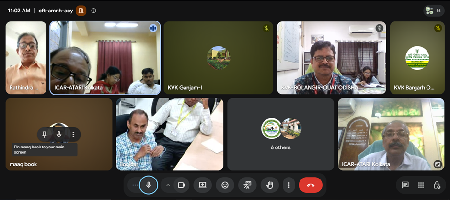
Addressing the challenge of extensive rice fallow areas and unlocking their untapped agricultural potential through oilseed cultivation has emerged as a strategic priority for Agricultural Technology Application Research Institute, Kolkata. In alignment with the clarion call of the top leadership of the Indian Council of Agricultural Research (ICAR), an online strategic interaction was organised by ICAR–Agricultural Technology Application Research Institute, Kolkata, with ICAR–Indian Institute of Oilseeds Research, Hyderabad, to develop a coordinated approach for addressing rice fallow situations across West Bengal and Odisha.
The initiative aligns with the vision of Dr M. L. Jat, Secretary, DARE & Director General, ICAR, to scientifically harness rice fallow lands through location-specific rabi pulses and oilseeds, leveraging technological interventions, institutional convergence and the extensive KVK network.
Addressing the participants, Dr Pradip Dey, Director, ICAR–ATARI Kolkata, highlighted that addressing rice fallow is not merely a matter of increasing cropping intensity but a strategic opportunity to transform the agricultural landscape, enhance farmers' income and strengthen India's edible oil security. He emphasised that rice-fallow lands should be recognised as productive agricultural assets rather than remaining uncultivated after the kharif paddy harvest.
He envisioned a mission-mode strategy for addressing rice-fallow through scientific mapping of fallow areas, assessment of residual soil moisture, identification of suitable short-duration oilseed varieties, timely seed availability, cluster-based frontline demonstrations and continuous farmer handholding. He particularly emphasised the need to develop location-specific interventions suited to the diverse agro-ecological conditions of West Bengal and Odisha.
Dr Dey further underscored the pivotal role of the KVKs in translating this national priority into field-level action. He called for strengthening research–extension–farmer linkages, with ICAR–IIOR providing technological backstopping and KVKs ensuring last-mile delivery, demonstration and adoption of appropriate oilseed technologies.
Experts shared technical perspectives on suitable oilseed crops and technological possibilities for addressing rice-fallow situations, highlighting the scope for collaborative interventions through the KVK network.
The Heads of KVKs from Odisha and West Bengal actively participated in the deliberations, sharing ground-level experiences, highlighting operational challenges and discussing practical solutions to strengthen effective implementation at the field level.
The interaction marks a significant step towards building an institutional action framework for addressing rice fallow areas through oilseed diversification. ICAR–ATARI Kolkata aims to mobilise its KVK network and strengthen collaboration with ICAR–IIOR to convert this untapped opportunity into tangible benefits for farming communities.
(Source: ICAR-Agricultural Technology Application Research Institute, Kolkata)