


Researchers at the ICAR-Central Rice Research Institute, Cuttack, have developed and experimentally validated a suite of artificial intelligence (AI)-designed genome-editing platforms for plants. The work centers on successful development of a novel genome-editing platform called Plant OpenCRISPR-1 (POC1), built upon OpenCRISPR-1 (OC1), an AI-generated nuclease. The CRRI team developed versatile POC1-based tools for gene knockout, precise base editing, and prime editing in plants.
Genome editing functions like a molecular scissor, enabling scientists to precisely alter a plant’s DNA to develop improved varieties without permanently introducing foreign genes. Until now, plant genome-editing tools have depended on proteins derived from bacteria and other naturally occurring microbes. The ICAR team’s work demonstrates that AI-designed enzymes can function robustly inside plant cells a capability not previously reported in plant systems.
The POC1 platform achieved editing efficiencies comparable to the widely used SpCas9 system across several rice genes and successfully generated gene disruptions in transformed rice plants. The ICARCRRI team also developed POC1-based base-editing and prime-editing tools, demonstrating robust activity and the ability to precisely rewrite genetic letters for targeted crop improvement.
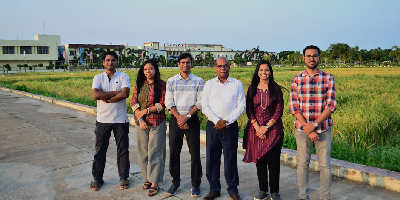
The study, accepted in the international plant science journal New Phytologist, marks a notable advance in agricultural biotechnology and contributes to India’s growing capabilities in next-generation crop improvement technologies.
The researchers demonstrated that an AI-designed enzyme can efficiently perform gene disruption and modify DNA letters at single-base resolution in a crop plant, using rice as the model system.
In crop improvement, these tools hold strong promise for fine-tuning traits such as grain quality, stress tolerance, nutritional content, and resistance to pathogens. By demonstrating that POC1-based base-editing and prime-editing tools function efficiently in rice, the ICAR team has established that AI-designed nucleases can serve as viable and versatile components for developing next-generation genome-editing platforms in agriculture.
Since OpenCRISPR-1 was released as an open-source nuclease and is proposed to be freely available for academic research and commercial licensing, it has the potential to broaden access to genome-editing technologies and represents an attractive alternative to SpCas9.
This research was supported by funding from Indian Council of Agricultural Research (ICAR). The work reflects India’s developing capabilities at the intersection of artificial intelligence, genome editing, biotechnology, and agricultural science, and holds promise for advancing the nation’s food security goals.
(Source: ICAR-Central Rice Research Institute, Cuttack)



Like on Facebook
Subscribe on Youtube
Follow on X X
Like on instagram