


28 April 2026, New Delhi
ICAR–Indian Agricultural Research Institute, New Delhi, in collaboration with the IARI Alumni Association (IAA), organized an expert lecture and interaction session at the institute. The lecture on “Innovations in Adaptation to Climate Change in Dryland Agriculture” was delivered by Prof. Kadambot Siddique, Hackett Professor of Agriculture Chair and Director, The UWA Institute of Agriculture, University of Western Australia (UWA), Australia.
Dr R. S. Paroda, President, IAA, formally introduced the speaker, highlighting his distinguished contributions to global agricultural research and leadership in dryland farming systems. He also outlined key milestones of the IAA and its significant contributions to nation-building and global agricultural platforms.
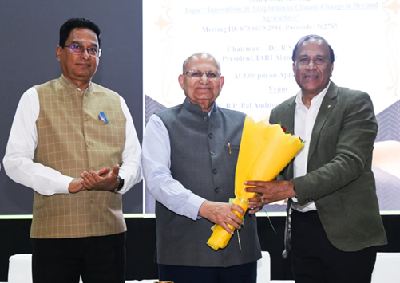
In his opening remarks, Dr Ch. Srinivasa Rao, Director, ICAR-IARI and Chief Patron, IAA, emphasized the institute’s role in achieving self-sufficiency in pulse production. He underscored the need to reduce greenhouse gas emissions through sustainable agricultural practices and highlighted the importance of effective science communication in addressing climate change challenges.
In his keynote address, Prof. Siddique elaborated on adaptation strategies to climate change in agricultural systems, with a particular focus on dryland and rainfed regions. He emphasized the urgency of addressing greenhouse gas emissions and presented case studies from China, Australia, and India to illustrate successful adaptation approaches.
He appreciated ICAR-IARI’s initiatives in fostering industry-oriented and research-driven opportunities for students. Encouraging young researchers, he stressed the importance of perseverance, noting that challenges and setbacks are integral to the innovation process.
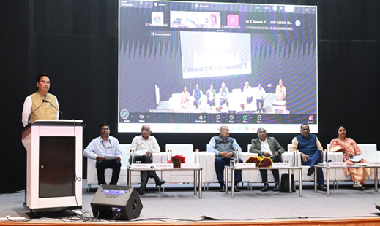
Prof. Siddique also discussed the global challenges posed by climate change, including increasing seasonal variability, shifting agricultural production zones, and heightened stress in dryland ecosystems. He highlighted the value of farmers’ experiential knowledge and emphasized that adaptation strategies should integrate and refine traditional practices through scientific interventions.
Noting that climate change will have a significant impact on future agricultural productivity, he called for region-specific strategies tailored to local agro-climatic conditions. He further emphasized the need for integrated approaches involving policy support, improved agronomy, crop breeding, and efficient resource management to strengthen resilience in dryland agriculture.
The session concluded with an interactive discussion, wherein faculty members and students actively engaged with the speaker on emerging challenges and potential solutions for climate-resilient agriculture.
(Source: ICAR-Indian Agricultural Research Institute, New Delhi)



Like on Facebook
Subscribe on Youtube
Follow on X X
Like on instagram