

21–22 May 2026, Barrackpore
Recognizing the escalating threat posed by invasive alien fishes to India’s freshwater biodiversity, fisheries, and livelihoods, a two-day National Workshop on “Invasive Exotic Fishes in Freshwater Ecosystems: Status, Knowledge Gaps and Future Research Priorities” was organized by ICAR–Central Inland Fisheries Research Institute, Barrackpore. The workshop addressed growing ecological and economic concerns arising from the proliferation of invasive fish species such as Nile tilapia, common carp, suckermouth armored catfish, and African catfish, which have established populations in several inland water bodies, contributing to biodiversity erosion, habitat disruption, ecosystem imbalance, and threats to fisheries-dependent livelihoods.
The workshop was inaugurated by Dr T.K. Datta, Vice-Chancellor, West Bengal University of Animal and Fishery Sciences, Kolkata, who underscored the critical need for inter-institutional collaboration, scientific innovation, and evidence-driven policy interventions to protect India’s indigenous aquatic biodiversity.
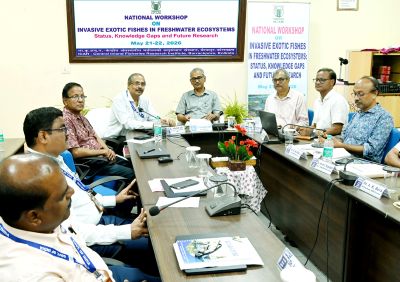
Dr Pradip Dey, Director, ICAR-CIFRI and Convener of the Workshop, called for urgent national action to combat the growing threat of invasive exotic fishes to India’s freshwater ecosystems. He stressed the need for a coordinated national framework integrating surveillance, ecological risk assessment, evidence-based policies, institutional convergence, and effective management strategies, while underscoring the role of science-led, community-centric approaches in safeguarding biodiversity, strengthening sustainable inland fisheries, and enhancing livelihood security in alignment with the vision of Viksit Bharat @2047 and a resilient Blue Economy.
The workshop brought together leading scientists, academicians, policymakers, and environmental experts from ICAR institutes, universities, and allied organizations across the country. Technical deliberations covered the distribution and pathways of invasive fish introductions, ecological and biodiversity impacts, climate change interactions, trophic alterations, ecosystem degradation, economic implications, and policy priorities for prevention and management.
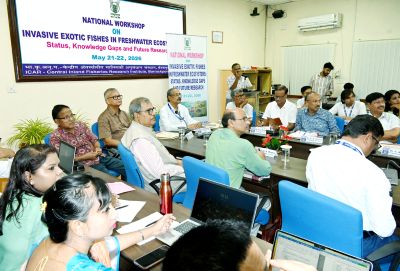
The experts contributed significantly to discussions on aquaculture biosecurity, quarantine protocols, risk assessment, and responsible aquaculture practices, stressing that stronger regulatory safeguards and preventive measures are vital to prevent accidental introductions and escape of exotic species into natural ecosystems.
Highlighting the multidisciplinary nature of invasive species management, divisional heads of ICAR-CIFRI outlined critical research and policy priorities. The speakers advocated long-term ecological monitoring and the development of national databases on invasive fish distribution. They also emphasized the need to understand trophic dynamics and ecosystem-level impacts, while highlighting the potential of molecular diagnostics and eDNA-based surveillance for early detection. Attention was also drawn to the socio-economic consequences for fisheries-dependent communities, alongside the importance of strengthening biosecurity frameworks, policy support, and inter-agency coordination.
The deliberations aligned closely with the objectives of the National Biodiversity Authority and the Convention on Biological Diversity, particularly in relation to national biodiversity targets on invasive species monitoring and inventory development.
A major outcome of the workshop was the formulation of a strategic national roadmap for assessment, monitoring, and management of invasive exotic fishes in India. Key recommendations included establishment of nationwide surveillance systems, predictive modelling of vulnerable ecosystems, standardized ecological and socio-economic assessment protocols, creation of a centralized national database, strengthening quarantine and biosecurity measures, and expanded stakeholder awareness and capacity-building programmes.
The workshop concluded with a strong call for integrated scientific research, early warning systems, and collaborative policy action to safeguard India’s freshwater ecosystems and ensure the sustainability of fisheries-based livelihoods.
(Source: ICAR–Central Inland Fisheries Research Institute, Barrackpore)



फेसबुक पर लाइक करें
यूट्यूब पर सदस्यता लें
X पर फॉलो करना X
इंस्टाग्राम पर लाइक करें