


30 June 2026, Bharatpur
In a significant initiative towards enhancing domestic edible oil production through sustainable and climate-resilient agricultural practices, the ICAR–Indian Institute of Rapeseed-Mustard Research, Bharatpur, in collaboration with Solidaridad and the Society for Rapeseed-Mustard Research (SRMR), Bharatpur, organized a national-level Stakeholders’ Consultation on “Regenerative Agriculture for Strengthening the Vegetable Oil Supply Chain.” The consultation brought together policymakers, scientists, industry leaders, government officials, extension agencies, financial institutions, Farmer Producer Organizations (FPOs), private-sector representatives, and progressive farmers to deliberate on strategies for developing a resilient, sustainable, and self-reliant vegetable oil sector in India.
The programme was inaugurated by Padma Shri Prof. (Dr) Arvind Kumar, Former Vice-Chancellor, Rani Lakshmi Bai Central Agricultural University, Jhansi, former Deputy Director General (Education), ICAR, and former Director, ICAR-IIRMR, Bharatpur, who graced the occasion as the Chief Guest. The inaugural session was chaired by Dr S.K. Jha, Assistant Director General (Oilseeds & Pulses), ICAR, New Delhi.
Distinguished Guests of Honour included Dr K.H. Singh, Director, ICAR–National Soybean Research Institute (NSRI), Indore; Dr R.K. Mathur, Director, ICAR–Indian Institute of Oilseeds Research (IIOR), Hyderabad (virtual mode); and Dr B.V. Mehta, Executive Director, Solvent Extractors’ Association of India (SEA), Mumbai (virtual mode).
In his keynote address, Prof. (Dr.) Arvind Kumar emphasized that regenerative agriculture is not merely an alternative production system but a long-term strategy for restoring soil health, conserving natural resources, enhancing climate resilience, and improving farmers’ livelihoods. He stressed the need for stronger collaboration among research institutions, extension agencies, industry stakeholders, and policymakers to accelerate the adoption of sustainable and resource-efficient farming practices.
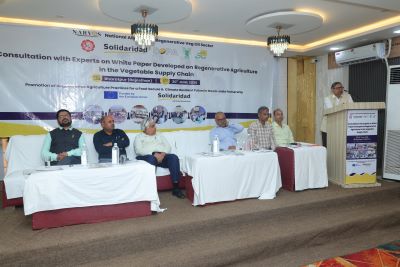
Addressing the gathering, Dr. S.K. Jha highlighted the importance of institutional convergence and rapid dissemination of regenerative agriculture technologies to achieve self-reliance in the edible oil sector. He emphasized the need for improving soil health, promoting balanced consumption patterns, developing innovative technologies including gene-edited oilseed varieties, and strengthening policy support mechanisms for enhancing the vegetable oil supply chain.
Dr. K.H. Singh underlined the importance of climate-resilient oilseed varieties and robust quality seed systems in enhancing productivity and farmers’ income. Sharing experiences from soybean-based production systems, he highlighted the positive impacts of natural farming practices while emphasizing that their promotion should be guided by local cropping patterns, climatic conditions, and soil characteristics.
Presenting the programme overview, Dr. Suresh Motwani, Programme Head (Vegetable Oil), Solidaridad, highlighted the role of regenerative agriculture in building sustainable vegetable oil value chains. He shared field-level experiences demonstrating the benefits of regenerative agricultural practices and underscored the importance of collaborative efforts among research organizations, government agencies, industry, and farming communities.
In his virtual address, Dr B.V. Mehta provided an overview of the future edible oil scenario in India and discussed the role of improved mustard production models in enhancing productivity and reducing import dependence. Dr. R.K. Mathur emphasized the importance of niche oilseed crops, availability of quality seed, and the growing role of Farmer Producer Organizations (FPOs) in promoting scientific cultivation practices and strengthening oilseed value chains.
Dr V.V. Singh, Director, ICAR-IIRMR, Bharatpur, emphasized that increasing domestic oilseed production is essential for ensuring India's nutritional, economic, and agricultural security. He highlighted the need for an integrated approach combining regenerative agriculture, improved technologies, quality seed systems, effective extension services, market linkages, and strong public-private partnerships.
The technical sessions focused on regenerative agriculture, research and development, policy support, institutional convergence, and value chain strengthening. Dr. D.N. Pathak, Executive Director, The Soybean Processors Association of India (SOPA), emphasized the need to strengthen soybean production and processing to improve edible oil security. Dr. R.S. Jat, Principal Scientist, ICAR-IIRMR, elaborated on the key pillars of regenerative agriculture and their role in improving soil health, enhancing resource-use efficiency, and building climate-resilient farming systems.
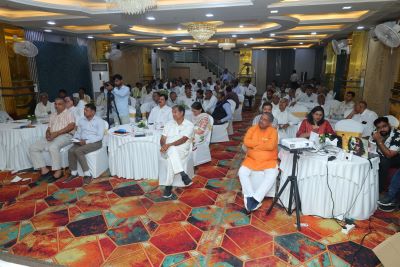
Valuable insights were also shared by Sh. Yogesh Sharma, Joint Director (Horticulture), Government of Rajasthan; Dr. Nawab Singh, Head, Krishi Vigyan Kendra, Kumher; Sh. Mahesh Sharma, Food Safety Officer, FSSAI; Dr. Shivam Agarwal, Branch General Manager, NABARD; Dr. Bhoj Raj Singh, Senior Breeder, Kaveri Seeds Pvt. Ltd.; Dr. M.L. Dotania, Senior Scientist; and Dr. Raj Kumar Yogi, Senior Scientist, ICAR-IIRMR. The speakers emphasized quality seed systems, technology dissemination, FPO-led development, credit support, food safety, entrepreneurship, and market linkages as key components of a sustainable vegetable oil ecosystem.
Dr. Vinod Kumar, Principal Scientist, ICAR-IIRMR, highlighted the growing role of digital technologies in agricultural information dissemination and stressed the importance of institutional partnerships in accelerating technology transfer, farmer outreach, and value chain development.
The consultation provided a vibrant platform for researchers, policymakers, industry representatives, financial institutions, and farmers to exchange ideas and formulate actionable strategies for enhancing oilseed productivity and promoting regenerative agriculture. The deliberations concluded with recommendations for strengthening research-extension-industry linkages, fostering institutional convergence, and accelerating technology dissemination to support the vision of Atmanirbhar Bharat in the edible oil sector.
(Source: ICAR–Indian Institute of Rapeseed-Mustard Research, Bharatpur)



फेसबुक पर लाइक करें
यूट्यूब पर सदस्यता लें
X पर फॉलो करना X
इंस्टाग्राम पर लाइक करें