

ICAR–Indian Grassland and Fodder Research Institute, Regional Research Station, Srinagar, has developed an innovative Apple- and Almond-Based Hortipasture Technology that integrates perennial fodder grasses and legumes within fruit orchards to address the recurring shortage of quality fodder in the temperate Himalayan region. The technology enables simultaneous production of fruits and fodder from the same land unit, while improving ecosystem services and promoting climate-resilient farming.
Temperate fruit-growing regions of the Himalayas often experience shortages of quality fodder, alongside underutilization of orchard floor spaces. To overcome this challenge, the institute has developed a sustainable hortipasture production system by establishing perennial fodder grasses such as orchard grass (Dactylis glomerata), tall fescue (Festuca arundinacea), and Lolium species, along with forage legumes including red clover and white clover, in the inter-row spaces of apple and almond orchards.
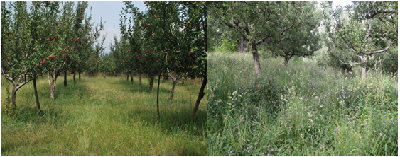
Under the recommended production protocol, fodder crops are planted approximately one metre away from tree trunks at a spacing of 30 × 40 cm. The first fodder harvest is taken 60–75 days after sowing, followed by successive harvests at 40–50-day intervals. For sustaining optimum productivity, nutrient management involving N:P @ 100:60:40 kg ha⁻¹ is recommended.
The integrated production system yields 35–40 tonnes of green fodder per hectare annually without adversely affecting fruit production. Apple orchards continue to produce 20–25 tonnes of fruits per hectare, while almond orchards yield 0.85–1.2 tonnes of nuts per hectare. The system can support 4–6 Adult Cattle Units (ACUs) per hectare, significantly improving on-farm fodder self-sufficiency.
Field-level adoption has demonstrated substantial economic benefits. Farmers implementing the technology reported 10–15% higher fodder yield and nearly 20% reduction in feed costs owing to the availability of quality fodder within their orchards.
Beyond productivity enhancement, the hortipasture system offers multiple ecosystem services compared with conventional orchard management. The perennial vegetative cover suppresses weeds by nearly 80%, thereby reducing herbicide dependence while improving soil organic matter, nutrient cycling, carbon sequestration, soil moisture conservation and biodiversity. Continuous ground cover also minimizes soil erosion and enhances the resilience of orchard ecosystems under changing climatic conditions.
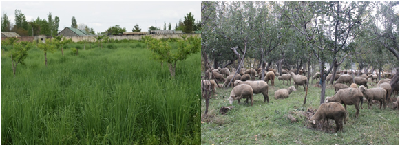
The technology has demonstrated remarkable impact in Choont Waliwar village of Ganderbal district, Jammu & Kashmir, where nearly 20 hectares across 75 orchards have been converted into hortipasture systems. Adoption by Gujjar and Pahari livestock-rearing communities has resulted in 20–25% higher fodder production and 15–20% increase in milk yield, transforming the village into a model fodder hub.
Salient Features
Simultaneous production of fruits and fodder from the same land unit.
Productive utilization of underexploited orchard floor spaces.
Annual green fodder production of 35–40 tonnes per hectare.
Supports 4–6 Adult Cattle Units per hectare.
Provides nearly 80% weed suppression, reducing herbicide use.
Enhances soil health, carbon sequestration, nutrient cycling and biodiversity.
Suitable for apple- and almond-based production systems in temperate regions.
Potential Impact
The Apple- and Almond-Based Hortipasture Technology offers a sustainable solution for enhancing fodder security, improving livestock productivity and reducing dependence on external feed resources. By integrating fruit and fodder production, the technology diversifies and stabilizes farmers' income while lowering production costs. In addition to improving soil health and carbon storage, it promotes climate-smart and sustainable intensification of temperate farming systems. Given its proven success under field conditions, the technology holds immense potential for large-scale adoption across the temperate Himalayan states and Union Territories.
(Source: ICAR–Indian Grassland and Fodder Research Institute, Regional Research Station, Srinagar)



फेसबुक पर लाइक करें
यूट्यूब पर सदस्यता लें
X पर फॉलो करना X
इंस्टाग्राम पर लाइक करें