

23 July 2026, Kolkata
ICAR–Agricultural Technology Application Research Institute, Kolkata organized an online meeting under the chairmanship of Dr Pradip Dey, Director-cum-Chairman, Zonal Programme Management Committee (ZPMC), Farmer FIRST Programme (FFP), to finalize the Action Plan for 2026–27 for the three Farmer FIRST Programme (FFP) centres under its jurisdiction.
The meeting was attended by Dr T. K. Datta, Vice-Chancellor, West Bengal University of Animal and Fishery Sciences (WBUAFS), Kolkata, and Prof. D. Basu, Vice-Chancellor, Uttar Banga Krishi Viswavidyalaya (UBKV), Cooch Behar, as Special Guests.
Dr A. Sarangi, Director, ICAR-Indian Institute of Water Management, Bhubaneswar; Dr S. Batabyal, Director Research, Extension and Farms (DREF), WBUAFS, Kolkata; and Dr P. K. Paul, In-charge, Directorate of Extension Education (DEE), UBKV, Cooch Behar, participated as Guests of Honour.
Scientists and project staff from ICAR-ATARI Kolkata, along with Principal Investigators (PIs), Co-Principal Investigators (Co-PIs) and Senior Research Fellows (SRFs) from the three FFP centres, also joined the meeting.
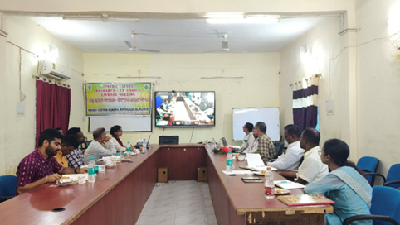
In his address, Dr Pradip Dey emphasized the immense scope for cross-learning among the three Farmer FIRST Programme centres, highlighting the distinct strengths of each institution—ICAR-IIWM in natural resource management (NRM)-based modules, WBUAFS in livestock and Integrated Farming System (IFS)-based modules, and UBKV in crop and horticulture-based modules. He advised the centres to collaborate with Farmer Producer Organizations (FPOs) and Farmer Producer Companies (FPCs) to extend the programme's reach to a larger farming community. Stressing the success of WBUAFS in developing master trainers for artificial insemination in goats, he recommended that similar capacity-building initiatives be undertaken by all centres to facilitate wider technology dissemination. Dr Dey also underscored the importance of leveraging digital technologies, climate-resilient interventions, value chain development and agri-entrepreneurship to contribute towards the vision of Viksit Bharat 2047.
Appreciating the efforts of the WBUAFS Farmer FIRST team, Dr T. K. Datta lauded the initiation of artificial insemination in goats within the project area. He requested enhanced financial support from the Council to strengthen training programmes, infrastructure development and field demonstrations at project sites.
Expressing his gratitude to the Council and the Agricultural Extension Division, Prof. D. Basu acknowledged the allocation of a new Farmer FIRST Programme Centre to UBKV, Cooch Behar. He highlighted the programme's unique focus on agro-ecology-based research and emphasized the need for systematic, long-term research aimed at developing successful and replicable technologies for the benefit of farmers.
Dr A. Sarangi stressed the importance of developing farmer-acceptable technologies while ensuring their evaluation, visibility and diversification across different agro-ecological systems. He emphasized that technology implementation should be aligned with the ecosystem of the target area, with sustainable development of the selected clusters remaining the primary objective.
Dr S. Batabyal appreciated the work being carried out by WBUAFS and expressed confidence that the development of master trainers for goat artificial insemination would significantly benefit farmers.
Highlighting the importance of sustainability, Dr P. K. Paul advocated for the development of energy-efficient technologies through the Farmer FIRST approach to promote green agriculture.
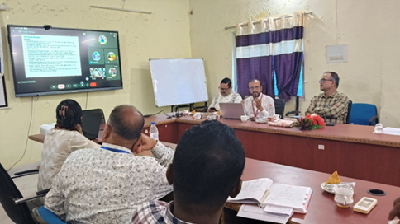
During the deliberations, several recommendations were made to strengthen programme implementation. The participants suggested promoting cross-learning among implementing centres through collaboration and convergence. For fruit orchards, intercropping or adopting a two-tier cropping system with seasonal vegetables and spices was recommended to enhance farmers' income. The adoption of the One District One Product (ODOP) approach was proposed for enterprise-based modules, while scaling up the milk value chain in adopted villages was also recommended. To strengthen backyard poultry, the promotion of low-cost incubators was suggested to facilitate local chick production and reduce dependence on commercial hatcheries.
The meeting also emphasized the need to encourage high-quality research publications. Participants recommended the use of IoT-enabled Alternate Wetting and Drying (AWD) devices for field data collection to generate reliable research outputs. It was further suggested that all measurable parameters for different interventions and technologies be identified before implementation to facilitate quality research publications. The inclusion of social science indicators was also recommended to enable comprehensive assessment of the project's social impact.
During the technical session, the Principal Investigators and Co-Principal Investigators from the three Farmer FIRST Programme centres presented their respective Action Plans for 2026–27. The proposed plans were critically reviewed by the dignitaries and panelists, who provided valuable suggestions and recommended incorporating the observations into the final action plans before implementation.
(Source: ICAR-Agricultural Technology Application Research Institute Kolkata)



फेसबुक पर लाइक करें
यूट्यूब पर सदस्यता लें
X पर फॉलो करना X
इंस्टाग्राम पर लाइक करें