

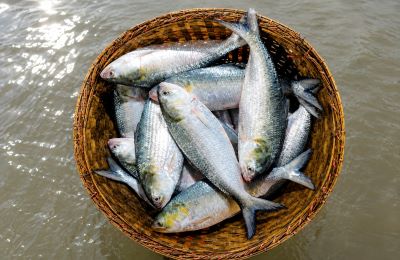
For decades, the iconic Hilsa (Tenualosa ilisha) had virtually disappeared from the middle and upper stretches of the River Ganga. Once a familiar migratory species that travelled from the Bay of Bengal deep into the river system, its upstream journey was severely disrupted following the commissioning of the Farakka Barrage in 1975. The resulting decline was not merely a loss of a fish species it also signalled a disruption in riverine ecology and affected the traditional livelihoods of fishing communities dependent on Hilsa.
Today, that story is beginning to change.
The recent appearance of Hilsa near Tanda Khurd village in Chandauli district, Uttar Pradesh, after remaining virtually absent from the upstream reaches for several decades, marks a significant milestone in India’s efforts towards river restoration, aquatic biodiversity conservation and livelihood security. It is compelling field evidence that with sustained scientific intervention, institutional commitment and community participation, even species that were once considered locally lost can begin to reclaim their historical habitats.
When a Migratory Journey Was Interrupted
Historically, Hilsa undertook a remarkable long-distance migration from the Bay of Bengal through the Ganga system, reaching as far upstream as Varanasi, Prayagraj and beyond. However, the commissioning of the Farakka Barrage in 1975 severely disrupted this migratory pathway, contributing to a drastic decline in Hilsa populations in the middle and upper Ganga. The ecological consequences were accompanied by economic impacts for riverine fishing communities whose livelihoods were closely linked to this highly valued fish.
Recognising the ecological, nutritional, cultural and livelihood significance of Hilsa, ICAR–Central Inland Fisheries Research Institute, Barrackpore, in collaboration with the National Mission for Clean Ganga (NMCG), initiated a long-term scientific programme aimed at restoring Hilsa fisheries in the Ganga. The initiative marked an important shift in the understanding of river rejuvenation—from focusing solely on water quality to embracing biodiversity restoration, fisheries productivity and the livelihoods of communities living along the river.
Science Meets the River
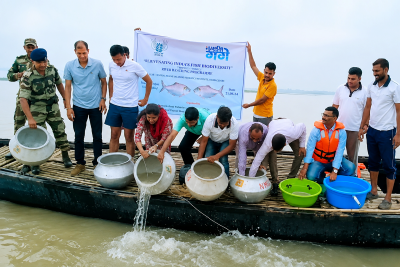
Restoring a migratory fish to a river system where its movement had been disrupted required more than simply releasing fish. ICAR-CIFRI adopted an integrated restoration strategy combining river ranching, stock enhancement, artificial breeding, release of fertilized eggs and hatchery-produced spawn, tagging and post-release monitoring, along with the participation of stakeholders and fisher communities.
Between 2019 and June 2026, the scale of these interventions grew substantially. More than 3.85 lakh juvenile and adult Hilsa were ranched, while over 40 lakh fertilized eggs and approximately 9.4 lakh hatchery-produced Hilsa spawn, aged 2–6 days, were released upstream of the Farakka Barrage. Tagging and systematic monitoring were undertaken to understand the fish’s migration, survival and movement patterns following release. Earlier tagging studies had already demonstrated the significant migratory capacity of Hilsa in the Ganga, providing valuable scientific evidence to guide restoration planning.
The objective was clear: not merely to increase fish numbers, but to create the conditions under which Hilsa could once again move through the Ganga and gradually re-establish itself within its historical range.
A Sign of Recovery Emerges
The results of this sustained effort are now beginning to become visible.
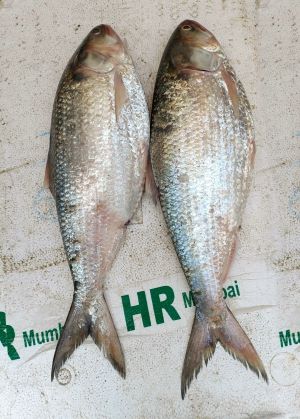
After nearly three decades, two Hilsa weighing a combined 740 grams were reported from Tanda Khurd village near Markandey Mahadev Temple in Chandauli district, Uttar Pradesh. Their appearance provides encouraging field evidence of upstream movement and the gradual re-establishment of Hilsa in a part of the Ganga where the species had remained virtually absent for decades.
This development did not occur in isolation. Monitoring undertaken during 2023–25 had already recorded the upstream movement of ranched Hilsa up to Mirzapur, indicating that the restoration process was progressing farther upstream. The latest observation from Chandauli therefore represents another encouraging step in a journey that is steadily extending towards the upper reaches of the Ganga.
More Than the Return of a Fish
The significance of Hilsa’s return extends far beyond the recovery of a single species.
As a highly sensitive migratory fish, Hilsa can serve as an important ecological indicator of river connectivity and habitat suitability. Its presence in the upper reaches therefore offers a biological signal of improving ecological functionality of the Ganga.
At the same time, the experience demonstrates that restoring riverine fisheries requires an integrated approach. Fish stocking alone cannot guarantee sustainable recovery. It must be complemented by habitat improvement, migratory connectivity, scientific monitoring, responsible fishing practices, community stewardship and inter-agency coordination. The continuing river-ranching initiatives of ICAR-CIFRI under NMCG reflect this broader approach towards restoring native fish diversity and strengthening sustainable riverine fisheries.
From Species Conservation to Ecosystem Restoration
Reflecting on the recovery of Hilsa, Dr Pradip Dey, Director, ICAR-CIFRI, emphasized that fisheries restoration should be viewed not merely as a species conservation effort, but as an integral component of ecological restoration and sustainable livelihoods. The emerging success of the programme underscores the importance of moving beyond species-specific interventions towards ecosystem-based river management, where fish migration, habitat quality, biodiversity conservation, water management and the livelihood needs of fishing communities are addressed together.
This perspective also carries a wider policy lesson: ecological restoration becomes truly meaningful when it contributes to social and economic resilience. The recovery of Hilsa populations can improve fish availability, create opportunities for livelihood diversification and strengthen the livelihood security of riverine fishing communities, while simultaneously conserving the ecological heritage and biodiversity of the Ganga.
A Model for Science-Led Conservation
The return of Hilsa to the upper Ganga is therefore more than a fisheries success story. It is a demonstration of what sustained scientific effort, institutional commitment and collaborative public policy can achieve in ecological restoration.
The partnership between ICAR-CIFRI and NMCG brings together fisheries science, river conservation, government support, field-level interventions and community participation within a coordinated restoration framework.
The reappearance of Hilsa also offers hope for other native and migratory aquatic species facing population decline. It reinforces a fundamental principle of conservation: rivers are living ecosystems, not merely channels for water management. Their health is reflected not only in their water quality, but also in the species they sustain, the ecological processes they support and the communities whose lives are intertwined with them.
The journey of Hilsa from the Bay of Bengal towards the upper Ganga is thus much more than the return of a fish. It is a story of ecological resilience, scientific perseverance and renewed hope for one of India’s most important rivers and the communities that depend upon it. Most importantly, it demonstrates that when conservation science is supported by sustained policy commitment and community participation, species once thought to have been lost from their historical habitats can begin their journey home.
(Source: ICAR-Central Inland Fisheries Research Institute, Barrackpore)



फेसबुक पर लाइक करें
यूट्यूब पर सदस्यता लें
X पर फॉलो करना X
इंस्टाग्राम पर लाइक करें