

21 August 2026, Nadia
As part of Parthenium Awareness Week 2026 (16 –22 August), ICAR-NDRI-KVK, Nadia organized an awareness programme for the students.
A total of 150 students participated in the programme, which aimed to sensitize young minds about the harmful impacts of Parthenium hysterophorus, commonly known as congress grass, on agriculture, human and animal health, water bodies and the environment.
Scientists of ICAR-NDRI-KVK, Nadia interacted with the students and explained that parthenium is a highly invasive weed that competes with crops for nutrients, water, light and space, thereby reducing agricultural productivity. The students were also sensitized about its adverse effects on human health, including allergic reactions, dermatitis and respiratory problems, as well as its potential harmful effects on livestock and grazing animals.
The programme also highlighted the environmental consequences of parthenium infestation. Uncontrolled growth of the weed can adversely affect biodiversity, suppress native vegetation and contribute to the deterioration of agricultural and surrounding ecosystems, including water bodies.
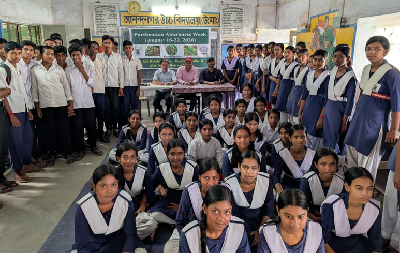
Different approaches for integrated management of parthenium were discussed during the programme. The KVK scientists highlighted cultural, mechanical, biological and chemical management options, emphasizing the importance of adopting suitable methods according to infestation levels and local conditions. Students were particularly advised to remove parthenium plants before flowering and seed formation to prevent further multiplication and spread of the weed.
The possibility of utilizing uprooted Parthenium as raw material for composting before flowering was also discussed, with emphasis on proper handling and safe composting practices. The students were encouraged to understand that timely removal and appropriate utilization can help reduce the weed seed bank and minimize its spread.
The scientists further emphasized that eradication of parthenium cannot be achieved through individual efforts alone. Active participation of the entire community-including students, farmers, teachers, local institutions and other members of society-is essential for sustainable management of this invasive weed.
The awareness programme concluded with a call for collective action to keep agricultural fields, roadsides, educational institutions and community areas free from parthenium, thereby safeguarding agricultural production, human and animal health, biodiversity and the environment.
(Source: ICAR-National Dairy Research Institute, KVK, Nadia, Kalyani)



फेसबुक पर लाइक करें
यूट्यूब पर सदस्यता लें
X पर फॉलो करना X
इंस्टाग्राम पर लाइक करें