

Tribal farmers in the sloping lands and uplands of Tripura have increasingly adopted rubber plantations, while others traditionally cultivate rice during the rainy season and leave their land fallow for the rest of the year. This limited and seasonal use of uplands restricts productivity and income opportunities.
To address this challenge, the Multitier Farming System Technology developed by ICAR–Research Complex for Eastern Region, Patna, is being demonstrated under the North Eastern Hill (NEH) component in collaboration with the ICAR-RCER, NEH Tripura Centre.
One of the beneficiaries, Smt. Swarna Debbarma, a tribal farmer from Barkathahal village of Hezamara Block, West Tripura, traditionally cultivated rice on her upland during the rainy season, leaving it fallow thereafter. The intervention is enabling her to bring the land under a diversified perennial-based production system, improving its year-round utilization.
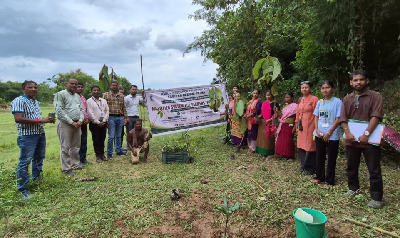
The technology combines teak as the upper-storey component, mango as the middle-storey fruit crop and ber as an additional fruit component, along with suitable intercrops. The arrangement optimizes the use of available space, sunlight, soil moisture and other farm resources while providing multiple income streams over different time periods.
Dr Anup Das, Director, ICAR-RCER, Patna, stated that the technology could serve as a viable alternative to the predominant rubber-based and rice-fallow systems in Tripura, which face challenges including price fluctuations and concerns related to land quality. He added that the approach offers fruit-based income in the medium term and long-term returns through timber, while promoting efficient resource use and conservation.
As part of the initiative, officials of Seven Sisters for Sustainable Agriculture (SeSTA) were trained by the ICAR-RCER team in system planning, layout preparation and planting techniques. The trained personnel are supporting field-level implementation and facilitating adoption among farmers.
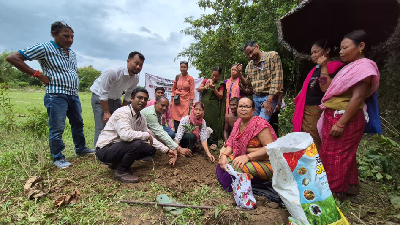
The intervention is converting previously underutilized rice-fallow uplands into productive, diversified farms. Intercrops can provide early and seasonal returns during the establishment phase, while mango and ber are expected to generate future fruit income and teak provide long-term returns.
The initiative highlights the potential of ICAR-RCER’s technology to improve the productivity and economic viability of rainfed uplands through scientific planning, capacity building and collaboration with local development organisations.
The technology is currently being demonstrated with 09 farmers covering approximately 3 hectares. During the field demonstration, 20 farmers participated, providing wider exposure to the approach and its potential benefits for sustainable upland agriculture and tribal livelihoods in Tripura.
(Source: ICAR–Research Complex for Eastern Region, Patna)



फेसबुक पर लाइक करें
यूट्यूब पर सदस्यता लें
X पर फॉलो करना X
इंस्टाग्राम पर लाइक करें