

How KVK Gumla Helped a Tribal Woman Farmer Build a Poultry and Hatchery Enterprise
For years, agriculture was the only source of livelihood for Mrs. Phool Kumari, a tribal woman farmer from Borang village in Bishunpur Block of Gumla district, Jharkhand. Like many farm families in the region, her household depended largely on rainfed farming, with traditional cultivation practices yielding limited returns.
Today, her story is different.
From a household earning around ₹50,000–60,000 annually from agriculture, Mrs. Phool Kumari has emerged as a poultry entrepreneur, integrating improved poultry farming and hatchery activities with agriculture. By 2025–26, her poultry enterprise generated a net annual income of ₹2,23,400, transforming not only her family's financial position but also her confidence and aspirations.
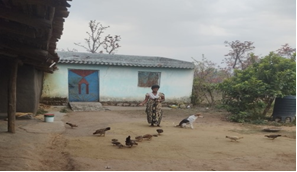
More importantly, her success has inspired around 30 tribal women in her village to take up improved backyard poultry farming.
Her journey demonstrates how the right combination of training, technology, improved breeds and continuous institutional handholding can turn a modest livelihood activity into a sustainable rural enterprise.
A Family Struggling with Low Farm Returns
Mrs. Phool Kumari lives with her husband, Mr. Jagdish Oraon, and their two children, aged 17 and 12 years. The family owns approximately 5 acres of land, comprising 2 acres of low-lying Don land and 3 acres of upland Tand land.
For many years, the family practised rainfed agriculture using traditional methods. Despite having land, the limited productivity and low returns from farming made it difficult to meet household expenses and support the education of their children.
Their annual income from agriculture was only around ₹50,000–60,000, leaving little room for investment in other livelihood activities.
The family needed not just better farming practices, but an additional and reliable source of income.
That opportunity came through KVK Gumla.
The Beginning of a New Journey
Mrs. Phool Kumari came in contact with Krishi Vigyan Kendra (KVK), Gumla, in 2016. Regular interaction with KVK scientists and technical experts gradually exposed her to improved agricultural practices and alternative livelihood opportunities.
In 2018, recognising her interest, family circumstances and the potential of poultry as a relatively low-investment livelihood activity, KVK scientists encouraged her to take up improved poultry farming.
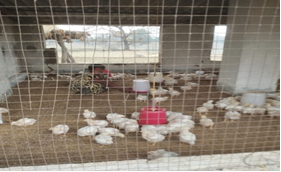
She underwent the necessary training and was subsequently supported with 100 Divyayan Red chicks under the Tribal Sub-Plan (TSP).
The intervention was designed to suit backyard farming conditions while providing opportunities for both meat and egg production.
For Mrs. Phool Kumari, this marked the beginning of a gradual transition—from conventional farming to livelihood diversification through scientific poultry management.
From Backyard Rearing to Scientific Poultry Farming
With the knowledge gained through training, Mrs. Phool Kumari established her poultry unit using locally available resources and adopted improved management practices.
She focused on:
Suitable poultry housing;
Scientific feeding and nutrition management;
Provision of clean drinking water;
Disease prevention and management; and
Regular care and maintenance of the birds.
The results were encouraging.
The birds attained an average body weight of approximately 1.5 kg within three months, while egg production began at around 22 weeks of age.
Her commitment to the enterprise and the promising performance of the birds convinced her that poultry could be more than a supplementary household activity—it could become a viable business.
The Hatchery: Taking the Enterprise a Step Further
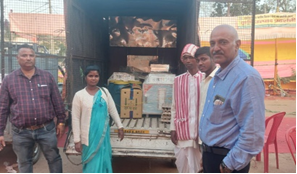
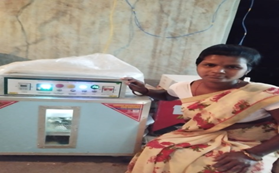
Recognising her progress, KVK Gumla further supported Mrs. Phool Kumari’s Self-Help Group (SHG) under the TSP project by facilitating a hatchery machine along with 112 eggs.
This intervention changed the scale and potential of her enterprise.
Instead of remaining dependent only on rearing birds, she could now explore chick production, creating an additional income stream while also addressing the local demand for improved poultry chicks.
The hatchery therefore became an important step in her transition from a poultry rearer to a small-scale poultry entrepreneur.
The combination of improved breeds, scientific management, hatchery technology and continued technical guidance enabled her to gradually build a more diversified and sustainable livelihood model.
The Numbers Tell the Story
By 2025–26, the poultry and hatchery enterprise had developed into a significant source of income.
During the year, Mrs. Phool Kumari sold approximately 1,000 adult birds at ₹400 per bird, generating a gross income of ₹4,00,000 against an input cost of approximately ₹2,25,000, resulting in a net income of ₹1,75,000.
The enterprise also generated income through the sale of approximately 960 chicks at ₹40 each, contributing ₹38,400, and around 1,000 eggs at ₹10 per egg, generating an additional ₹10,000.
Overall, the enterprise generated:
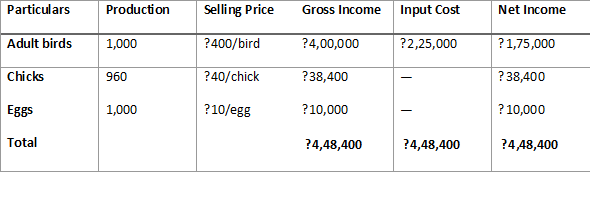
Thus, her additional net annual income increased to approximately ₹2,23,400 in 2025–26, compared with around ₹50,000–60,000 from agriculture before the intervention.
The numbers represent more than an increase in income. They reflect a fundamental change in the family's livelihood security.
When Income Became an Investment in the Family’s Future
The additional income generated through poultry farming enabled the family to make investments that had previously been difficult to afford.
One of the most significant outcomes was the purchase of an auto-rickshaw, which is now operated by her husband, Mr. Jagdish Oraon. The vehicle has created another source of household income, further strengthening the family's livelihood base.
The increased financial stability has also eased the pressure associated with the education of their children.
The family is now better positioned to meet its educational and household requirements, while Mrs. Phool Kumari herself has gained greater confidence in managing an enterprise and making livelihood-related decisions.
In her own words:
“The poultry hatchery unit and technical guidance provided by Krishi Vigyan Kendra have brought a positive change in our economic condition. With the additional income, we were able to purchase an auto, which my husband now drives to earn further income. The education of our children is no longer a burden for us. Poultry farming has helped us become small entrepreneurs. We are now becoming economically and socially empowered and feel much more confident and motivated.”
One Woman’s Success Inspires Many More
Perhaps the most significant impact of Mrs. Phool Kumari’s journey can be seen beyond her own household.
Her poultry unit became a demonstration for other women in Borang village. Inspired by her experience, approximately 30 tribal women have adopted improved backyard poultry farming.
These women are also purchasing eggs from Mrs. Phool Kumari’s unit and are increasingly adopting improved breeds such as Sonali and Divyayan Red.
Each participating woman is reportedly generating an additional annual income of approximately ₹35,000–45,000 through poultry farming.
Thus, what began as an intervention for one farm family gradually developed into a community-level livelihood model. Mrs. Phool Kumari is no longer only a beneficiary of an agricultural intervention; her enterprise has become a local source of knowledge, chicks and inspiration for other women.
A Ripple Effect of Rural Entrepreneurship
The experience demonstrates the multiplier effect that can emerge when a successful farm intervention is supported by continuous institutional guidance.
The initial support of improved chicks was followed by training, scientific management, hatchery assistance and technical handholding. Each intervention built upon the previous one, enabling the enterprise to grow organically.
The resulting model combines:
Improved poultry breeds + scientific management + hatchery technology + women’s participation + market-oriented production = diversified rural enterprise.
It has also demonstrated that livelihood diversification can strengthen the resilience of farm households by reducing dependence on a single source of income.
Key Outcomes
The intervention led to several important outcomes:
Annual net income increased to ₹2,23,400 in 2025–26, compared with approximately ₹50,000–60,000 from agriculture before the intervention.
A small-scale poultry and hatchery enterprise was established.
Improved poultry breeds and scientific management practices were adopted.
The family diversified its livelihood through the purchase and operation of an auto-rickshaw.
Increased income improved the family's ability to support the education of their children.
Mrs. Phool Kumari developed greater entrepreneurial confidence and economic empowerment.
Approximately 30 tribal women in Borang village adopted improved backyard poultry farming.
Participating women generated an additional annual income of approximately ₹35,000–45,000 each through poultry farming.
The beneficiary's poultry unit emerged as a local source of improved chicks and eggs, supporting wider adoption within the community.
From One Enterprise to a Community Opportunity
The journey of Mrs. Phool Kumari illustrates that rural transformation does not always begin with a large investment. It can begin with one farmer, one training programme and one opportunity to try something different.
What started with 100 improved chicks gradually evolved into a poultry and hatchery enterprise. The income generated from the enterprise strengthened her family's financial security, enabled investment in another livelihood activity and reduced the burden of children's education.
But the most enduring impact lies in the ripple effect.
Today, around 30 tribal women from the same village are exploring improved backyard poultry farming, creating their own additional income opportunities.
The experience of KVK Gumla demonstrates the potential of women-centred, technology-supported livelihood diversification to strengthen rural households, particularly in tribal communities where agriculture alone may not provide sufficient and stable returns.
Conclusion: When Knowledge Becomes Opportunity
Mrs. Phool Kumari’s story is a testament to what can happen when traditional farming families are connected with the right knowledge, technology and institutional support.
From a household dependent on low-return rainfed agriculture, she has built a diversified livelihood combining farming, poultry rearing and hatchery activities. Her enterprise has enhanced household income, supported her children’s education, created an additional family livelihood through an auto-rickshaw and inspired other tribal women to follow a similar path.
The experience of KVK Gumla shows that scientific poultry farming can serve as an effective pathway for livelihood diversification among small and tribal farm households.
Most importantly, the story demonstrates that the impact of an agricultural intervention can extend far beyond the individual beneficiary. When one woman acquires the confidence to become an entrepreneur, an entire community can begin to see new possibilities.



फेसबुक पर लाइक करें
यूट्यूब पर सदस्यता लें
X पर फॉलो करना X
इंस्टाग्राम पर लाइक करें