


How KVK Bishnupur’s Demonstration of Arka Abhed is Helping Farmers Explore a More Resilient and Profitable Tomato Crop
For farmers in Bishnupur district of Manipur, tomato is much more than a vegetable. It is a dependable commercial crop and an important source of household income. Cultivated throughout the year, tomato finds a place in almost every household kitchen and is an essential ingredient in a wide range of vegetarian and non-vegetarian dishes.
However, cultivating tomato during the Rabi season comes with its own set of challenges. Falling temperatures and frost can affect crop growth and productivity, while limited access to improved varieties suitable for such conditions often leaves farmers dependent on commercially available F1 hybrids. The high cost of hybrid seed, in turn, adds to the overall cost of cultivation.
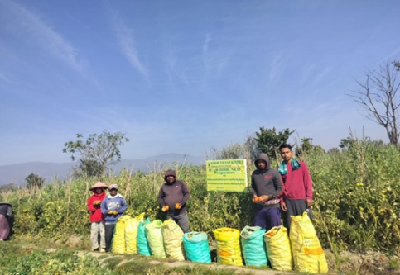
It was against this backdrop that Krishi Vigyan Kendra (KVK), Bishnupur, introduced farmers to a promising alternative—Arka Abhed, an F1 hybrid developed by ICAR–Indian Institute of Horticultural Research (ICAR-IIHR), Bengaluru.
The objective was straightforward: to demonstrate the performance of an improved tomato hybrid under the actual field conditions of Bishnupur and enable farmers to assess its potential for themselves.
The results generated considerable interest.
A Demonstration with a Purpose
Tomato occupies around 281 hectares in Bishnupur district, producing approximately 6,144 MT annually. The district’s subtropical climate is generally favourable for tomato cultivation, with the crop performing optimally at temperatures of around 20–25°C and in well-drained, fertile loamy soils with a pH of 6.0–6.8.
Yet, Rabi cultivation remains challenging because of low temperatures and frost.
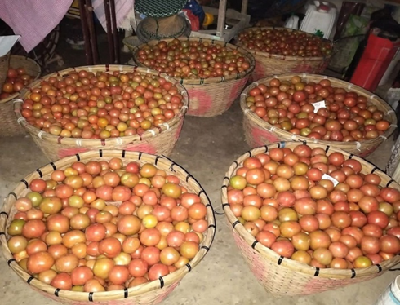
To address this challenge and promote the adoption of improved tomato varieties, Dr P. Bijaya Devi, Subject Matter Specialist (Horticulture), KVK Bishnupur, facilitated the introduction and demonstration of Arka Abhed in collaboration with ICAR-IIHR under the NEH Component.
As part of a seed distribution-cum-capacity-building programme held at KVK Bishnupur in August 2025, seeds of Arka Abhed were distributed to 10 selected farmers from different villages of Bishnupur district, including Langpok, Kabowakching, Bishnupur Ward No. 11, Khoijuman and Kumbi.
Each participating farmer received seed for field-level demonstration and was guided on scientific cultivation practices through group discussions and capacity-building sessions.
The aim was not merely to distribute seed, but to create an opportunity for farmers to see, compare and evaluate the variety under their own agro-climatic conditions.
From Seed to Harvest
The farmers followed the recommended package of practices for Rabi-season tomato cultivation.
The seeds were sown on raised beds during the first week of September 2025, followed by transplanting towards the end of September. Farmyard manure was incorporated during the final ploughing, while recommended doses of nitrogen, phosphorus and potassium were applied in split doses.
Each farmer cultivated the crop over an area of at least 625 m². The crop was established on raised beds, with irrigation provided immediately after transplanting and subsequent nutrient management carried out at appropriate crop stages.
The intervention combined improved planting material with scientific crop management, allowing farmers to assess the performance of Arka Abhed under the low-temperature conditions characteristic of the Rabi season.
Then came the real test the field.
When the Crop Faced the Frost
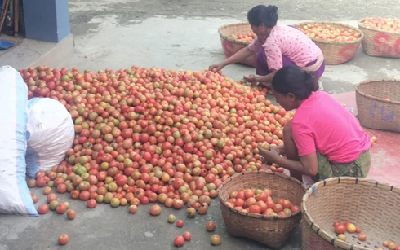
The first picking of Arka Abhed began at around 70 days after transplanting, and harvesting continued for approximately 105 days.
During the Rabi season, the crop encountered heavy frost conditions in parts of Manipur. Despite the challenging conditions, Arka Abhed demonstrated a notable level of tolerance and continued to produce marketable fruits.
This performance caught the attention of the farmers.
The participating farmers particularly appreciated the hybrid for its disease resistance, tolerance to frost and thick-skinned fruits, which they considered advantageous for marketing and handling.
The timing also worked in the farmers’ favour. As tomato availability was relatively lean during the period, the fruits commanded a favourable market price of around ₹35–50 per kg.
For the farmers, the demonstration had moved beyond being an experimental exercise. The crop was showing its potential where it mattered most—in the field and in the market.
A Field Day Where Farmers Became the Evaluators
The impact of the demonstration became particularly visible during a Farmers’ Field Day organised on 10 February 2026 at the field of Shri Ch. Khogendro Singh at Khoijuman, Bishnupur district.
With the crop at the full fruiting stage, the event provided farmers with an opportunity to observe the growth, fruiting and field performance of Arka Abhed first-hand. A total of 50 farmers participated in the programme.
The event effectively demonstrated the extension principle of “Seeing is Believing.”
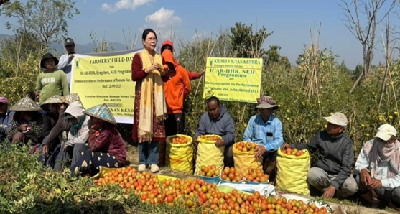
Instead of relying solely on information provided during training programmes, farmers could see the crop, examine the fruits and interact around its performance under actual Rabi-season conditions.
The response was encouraging. Neighbouring farmers expressed interest in adopting Arka Abhed and other suitable Arka varieties, along with the recommended scientific cultivation practices.
Thus, the demonstration began creating a horizontal spread of the technology, with farmers themselves becoming important ambassadors of the innovation.
From 625 m² to ₹2.34 Lakh in Net Returns
The economic performance further strengthened the case for the variety.
Under the demonstration, an average yield of 67.1 quintals from 625 m² was recorded. The crop involved a cultivation cost of approximately ₹27,800, while the gross return reached around ₹2,62,400, resulting in a reported net return of ₹2,34,600.
With market prices ranging between ₹35 and ₹50 per kg, the crop offered an attractive economic opportunity during the lean season.
For farmers accustomed to high-cost commercial hybrids, the demonstration also opened up the possibility of exploring improved Arka hybrids as alternatives, wherever agronomically suitable and seed availability permits.
One Farmer’s Experience: Shri Ch. Khogendro Singh
Among the farmers who witnessed the potential of Arka Abhed was Shri Ch. Khogendro Singh of Khoijuman village.
With nearly 25 years of farming experience, Shri Khogendro Singh was already familiar with improved horticultural varieties. Over the years, he had cultivated several Arka varieties, including yard-long bean Arka Mangala (F1), tomato hybrids Arka Rakshak and Arka Samrat, and chilli hybrids such as Arka Meghana and Arka Khyati.
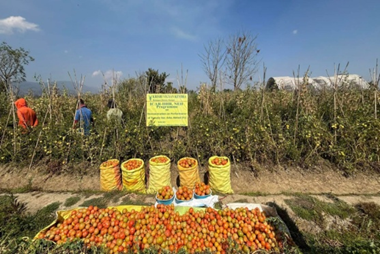
After participating in the capacity-building and seed distribution programme organised by KVK Bishnupur in collaboration with ICAR-IIHR, he decided to take up the cultivation of Arka Abhed during the Rabi season.
The results strengthened his confidence.
Following the recommended package of practices, he obtained a high yield and substantial net returns within a crop duration of approximately five months. More importantly, he observed the performance of the hybrid under frost-prone Rabi conditions and found its frost tolerance, disease resistance and thick-skinned fruits particularly useful.
His experience has encouraged him to plan year-round cultivation of suitable Arka tomato varieties, supported by scientific crop rotation and crop diversification.
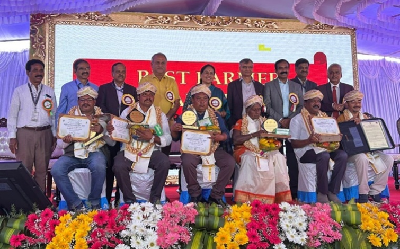
His track record as a progressive farmer adds further significance to the demonstration. Shri Khogendro Singh was also conferred the Best Farmer Award at the ICAR-IIHR National Horticulture Fair 2025, Bengaluru.
A Technology Gaining Ground
The experience of Arka Abhed in Bishnupur demonstrates how a well-designed field demonstration can bridge the gap between research and adoption.
The intervention brought together improved planting material, scientific crop management, farmer training and field-level validation. More importantly, it allowed farmers to evaluate the technology in the conditions they actually face.
The encouraging performance during the Rabi season and the favourable economic returns generated interest among participating and neighbouring farmers. Farmers have expressed interest in expanding the area under Arka tomato cultivation and exploring suitable Arka hybrids as alternatives to high-cost commercially available F1 hybrids.
The initiative therefore has the potential to contribute to lower seed-related costs, improved productivity and enhanced profitability, subject to local performance, availability of quality seed and suitability of the variety to specific farming conditions.
Looking Ahead
The experience from Bishnupur points towards a larger opportunity for strengthening tomato cultivation in Manipur.
Wider dissemination of suitable improved varieties, coupled with timely availability of quality seed, farmer training and scientific crop management, can help farmers make more informed varietal choices. Continued demonstrations across different locations and seasons can further establish the adaptability and economic performance of Arka Abhed under diverse field conditions.
The success of the intervention also highlights the importance of farmer-to-farmer learning. When a promising crop stands successfully through frost, produces quality fruits and generates attractive returns, the demonstration field itself becomes a powerful classroom.
From Demonstration to Possibility
The story of Arka Abhed in Bishnupur is ultimately a story of farmers exploring new possibilities.
A crop challenged by frost became an opportunity to test resilience. A field demonstration became a platform for farmer learning. And a new tomato hybrid became a potential pathway towards improved profitability.
Through the efforts of KVK Bishnupur and ICAR-IIHR, scientific innovation was brought directly to farmers’ fields, where its value could be assessed not merely through technical parameters, but through crop performance, marketability and returns.
As more farmers show interest in the technology, Arka Abhed is emerging as a promising option for Rabi-season tomato cultivation in Bishnupur demonstrating once again that when improved technology meets farmer experience and the right field conditions, innovation can translate into opportunity and opportunity into livelihood.



फेसबुक पर लाइक करें
यूट्यूब पर सदस्यता लें
X पर फॉलो करना X
इंस्टाग्राम पर लाइक करें