

Groundnut cultivation in many rainfed and semi-irrigated regions often faces significant challenges such as poor seedling establishment, susceptibility to seed- and soil-borne diseases, and inefficient utilization of crop inputs. Conventional seed treatment methods usually involve the single-step application of chemicals, which may result in uneven distribution of inputs and incompatibility with beneficial bioagents. These limitations often lead to suboptimal crop growth and reduced productivity, particularly under stress conditions.
To address these constraints, ICAR–Indian Institute of Oilseeds Research, Telangana developed an innovative biopolymer-enabled multilayer seed coating technology. The technology is designed to deliver multiple crop inputs including beneficial microbes, biostimulants, micronutrients, and reduced-dose chemical protectants through a carefully structured coating system that ensures spatially and temporally controlled release of these components.
Under the Farmers FIRST Programme of ICAR, this technology was demonstrated at Rampur Thanda village in Vikarabad district of Telangana. In the demonstration plots, groundnut seeds were treated with specially designed functionally modified biopolymer multilayer coatings. The coating architecture included a primer layer to ensure strong adhesion to the seed coat, followed by functional layers carrying compatible bioagents and crop inputs. For comparison, farmers’ conventional seed treatment practices were maintained as control.
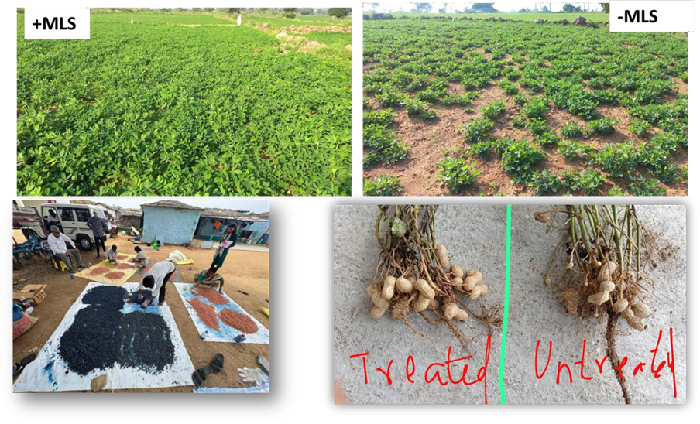
The field demonstrations conducted during Early Kharif 2025–26 on 6 hectares and Rabi 2025–26 on 18 hectares showed clear advantages of the multilayer seed coating technology. During Early Kharif, the multilayer seed-coated treatment recorded a yield of 15.7 q ha⁻¹, compared to 12.3 q ha⁻¹ under farmers’ practice. Similarly, in the Rabi season, yields reached 22.74 q ha⁻¹, significantly higher than 17.85 q ha⁻¹ under conventional practice. Overall, the technology demonstrated an average yield advantage of about 27.5 percent over farmers’ practice.
Economic analysis further highlighted the benefits of the technology. On an area-weighted annual basis across 24 hectares, the improved technology achieved an average yield of 20.98 q ha⁻¹, compared to 16.46 q ha⁻¹ under traditional practices. This translated into gross returns of ₹1,75,727 per hectare, compared with ₹1,41,068 per hectare under farmers’ practice. Notably, the cost of cultivation decreased by about 17 percent, reflecting improved input-use efficiency. As a result, net returns increased significantly to ₹1,28,332 per hectare, compared to ₹83,829 per hectare in the conventional system. The benefit–cost ratio improved from 2.53 to 3.70, representing a 46 percent economic advantage.
Beyond productivity and profitability, the technology demonstrated several agronomic benefits. The multilayer coating improved early crop establishment and plant vigor, enhanced tolerance to biotic and abiotic stresses, and enabled efficient use of multiple crop inputs at reduced dosages. These advantages collectively contributed to improved crop performance and sustainability.
Farmers participating in the demonstrations reported positive experiences with the technology, highlighting better crop growth, improved yields, and enhanced profitability. The success of the demonstrations generated considerable interest among farmers in Vikarabad district, many of whom expressed willingness to adopt the technology in future seasons.
The successful implementation at Rampur Thanda clearly demonstrates the potential of biopolymer-enabled multilayer seed coating technology to improve groundnut productivity, enhance farm income, and promote efficient resource use. The consistent performance across seasons confirms its robustness under diverse field conditions.
Given its farmer-friendly, environmentally safe, and economically viable nature, the technology holds strong potential for large-scale adoption in groundnut-based production systems. It also offers promising opportunities for inclusion in frontline demonstrations, seed production programmes, and sustainable seed intensification strategies, contributing to improved livelihoods and resilient agricultural systems.
(Source: ICAR–Indian Institute of Oilseeds Research, Telangana)



फेसबुक पर लाइक करें
यूट्यूब पर सदस्यता लें
X पर फॉलो करना X
इंस्टाग्राम पर लाइक करें